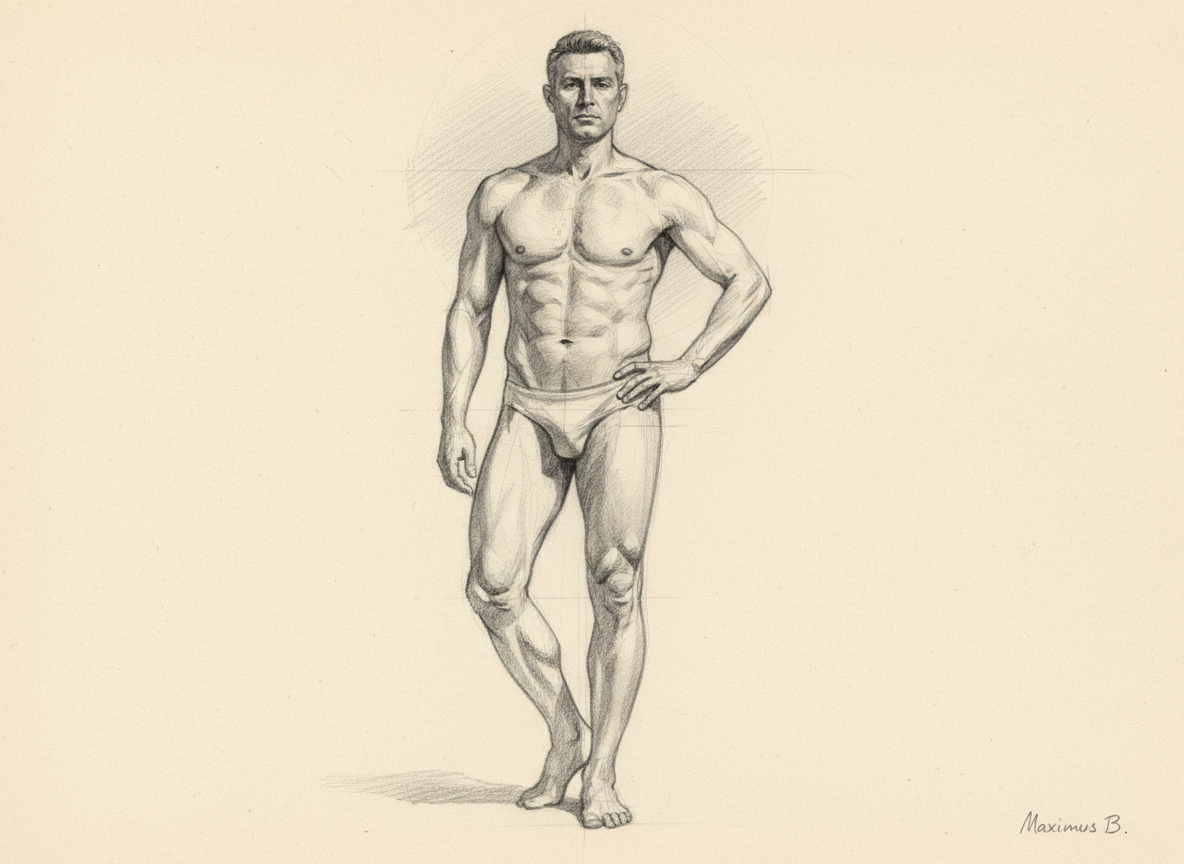
Drawing arms with natural asymmetry is one of the fastest ways to make a figure feel human. Real arms are never twins. One forearm is slightly thicker. One elbow sits a touch higher. One wrist relaxes differently. The differences are small — but the eye notices their absence immediately.
The mistake is not that artists miss anatomy. It’s that they “correct” the body into symmetry while they draw. The goal is not to exaggerate imbalance. The goal is to keep what is already there.Model age range (internal): 26–42.
Drawing Arms with Natural Asymmetry: Where to Look First
Start with the big relationships — not muscle names. When the pose is relaxed, asymmetry usually shows up in:
- Shoulder height: one acromion higher, one clavicle more open.
- Elbow position: one elbow slightly forward/back in space.
- Forearm twist: pronation vs supination changes the silhouette.
- Hand tension: one hand holds, the other releases.
If you keep these four in mind, the arms stop being “two tubes” and become two different events.
The Symmetry Trap
Symmetry feels like correctness. You level the shoulders. You match the biceps. You mirror the wrists. The drawing becomes clean — and dead.
A useful rule: if you find yourself “fixing” the arm, pause and check whether you’re fixing the model or fixing your drawing. Most of the time, you’re fixing the model.
A Practical Measuring Method (No Overthinking)
- Drop a light vertical plumb line from the pit of the neck.
- Compare the two shoulders against that line.
- Compare elbow heights.
- Compare wrist positions.
- Finally, compare the negative shapes between arm and torso.
Negative shapes are the truth serum. If the gap between arm and torso is different on each side, your drawing must respect that.
Graphite Rendering: Let the Strokes Keep It Honest
In graphite, symmetry is often reinforced by smoothing. When you blend everything into a perfect gradient, you erase the small differences.
Keep construction lines visible. Let stroke direction follow the cylinder of the arm. If you want a focused daily drill for this, read: Graphite Stroke Direction and Anatomy.
A 12-Minute Practice Drill
- Draw the gesture and place the ribcage/pelvis masses.
- Place both shoulders and both elbows with simple points.
- Draw the arm cylinders with a centreline showing twist.
- Shade only the shadow family on each arm (one unified mass).
- Stop before details.
Repeat three times. The aim is not a finished drawing — it’s a believable pair of arms that do not look manufactured.
Supporting Visual Studies (Full Body)
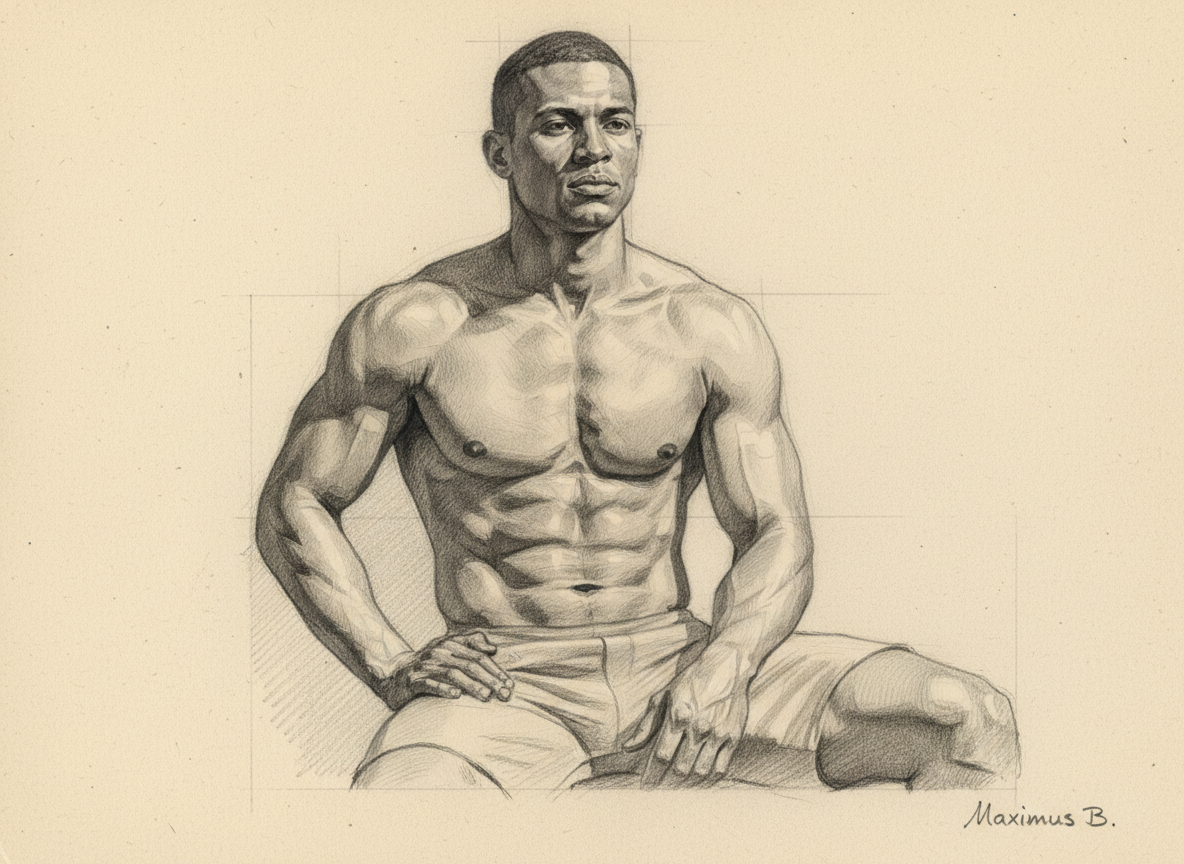
Two supporting studies for today’s topic. Each is a full-body graphite study with visible construction lines and the signature in the lower right.
The Complete Path
Natural asymmetry is not a separate style. It’s what happens when you draw weight, structure, and observation honestly. For the broader principle, continue with: Natural Asymmetry in Male Figure Drawing.
And for the full course structure — from first gesture marks to finished graphite rendering — explore: Mastering the Male Figure.