Torso twist and rotation in graphite figure drawing is where most drawings either come alive or collapse. The moment the ribcage and pelvis face different directions, the figure gains tension, weight, and the sense that it exists in real space. Without it, even a well-proportioned figure looks like a diagram. Model age range (internal): 26–42.
The key is understanding that the torso is not one block. It is two masses — ribcage and pelvis — connected by a flexible spine. In most poses, they do not face the same direction. That difference is the twist.
Torso Twist and Rotation: See the Two Masses First
Before you draw any anatomy, establish the ribcage and pelvis as separate volumes with their own orientations. Ask:
- Which direction does the ribcage face?
- Which direction does the pelvis face?
- How much do they differ?
Even a small difference — five or ten degrees — is enough to create a living torso. A large difference creates drama and movement.
The Spine as a Connector, Not a Straight Line
The lumbar spine connects the ribcage to the pelvis. In a twisted pose, it curves. The side that compresses shortens; the side that stretches lengthens. This is the oblique rhythm — and it is the most visible surface evidence of the twist.
For the full oblique rhythm lesson, read: Obliques and Torso Rhythm: How to Draw the Side of the Male Torso.
Mapping the Twist in Graphite
- Draw the ribcage as a barrel. Mark its centre line and the direction it faces.
- Draw the pelvis as a wedge. Mark its centre line and the direction it faces.
- Connect them with a spine curve. The curve shows the degree of twist.
- Map the shadow family. In a twisted torso, the shadow boundary is rarely vertical — it follows the twist.
- Shade as one mass. Keep the shadow unified before adding anatomical detail.
The Most Common Mistake
Artists draw the sternum line and the pelvis centre line perfectly parallel. The result is a torso that looks stiff, even if the arms and legs are in a dynamic pose.
The fix: before you shade anything, check that your ribcage centre line and your pelvis centre line are pointing in different directions. If they are parallel, the torso is not twisted — it is just tilted.
A 12-Minute Drill
- Choose a reference with a clear torso twist (seated rotation works well).
- Draw only the ribcage barrel and pelvis wedge — no limbs, no head.
- Mark both centre lines and confirm they face different directions.
- Add the spine curve connecting them.
- Block in the shadow family as one unified mass.
- Stop. Repeat three times from different references.
Supporting Visual Studies
Two supporting full-body studies for today's topic — each exploring torso twist under different conditions. Models read adult 26–42.
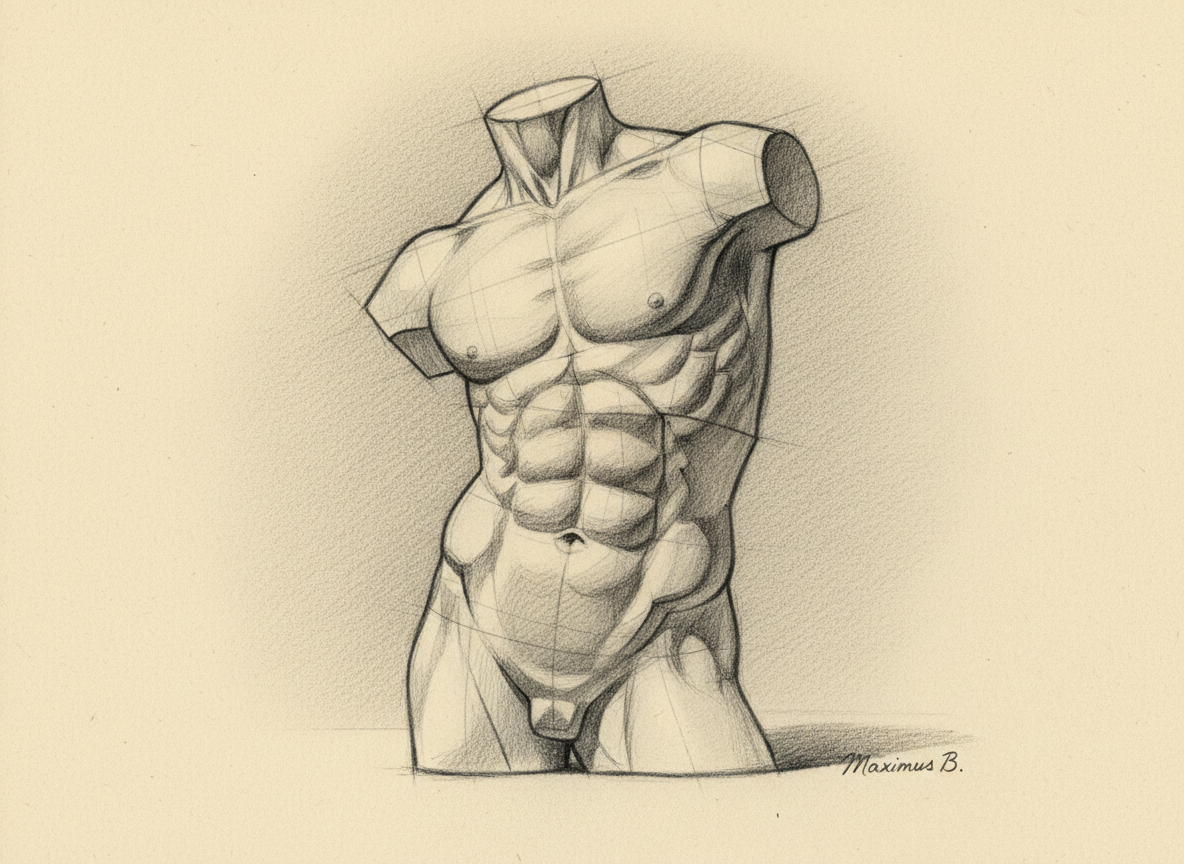
Study A — Standing rotation, model reads 28–40.
Study B — Seated twist, model reads 26–38.
The Complete Path
Torso twist and rotation are expanded across multiple stages in Mastering the Male Figure. If you keep one principle close, keep this one: the torso is two masses, not one. When they face different directions, the figure lives.