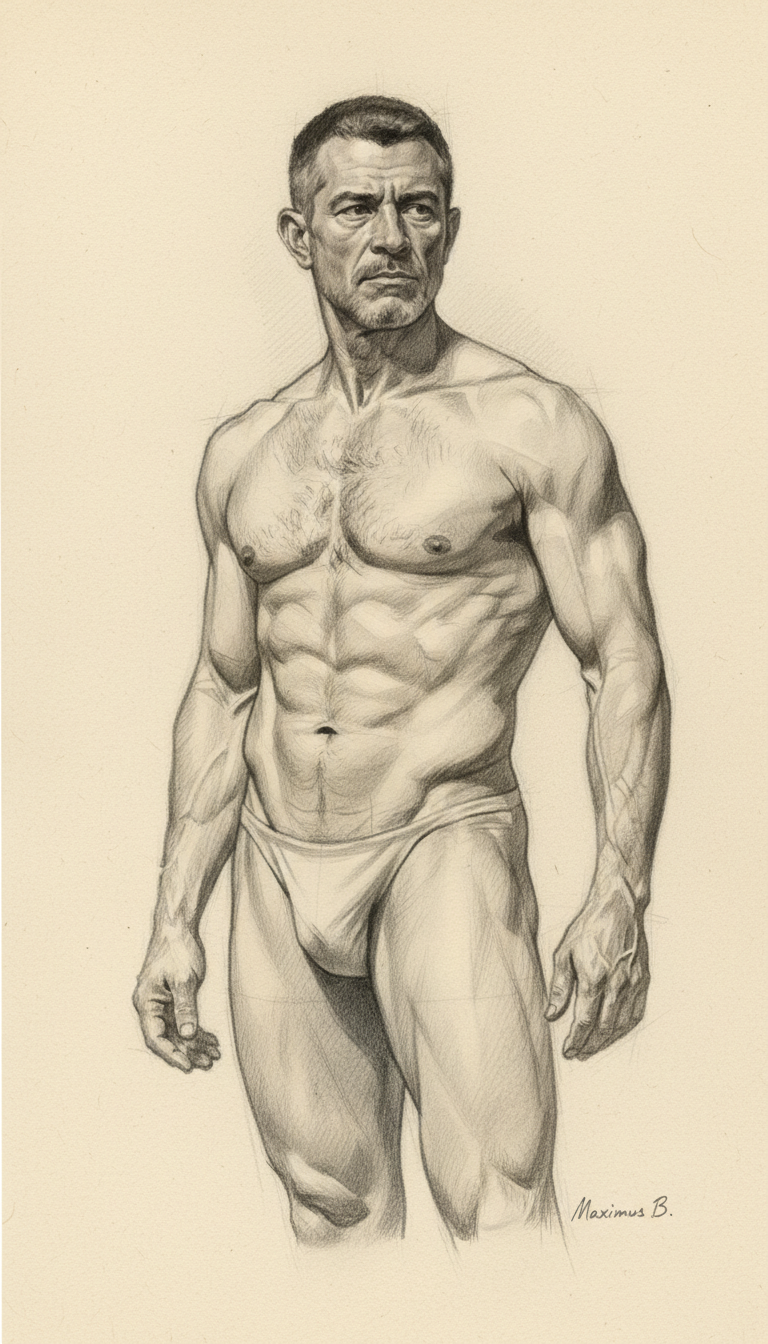
The oblique muscles are among the most important — and most overlooked — surface features of the male torso. They define the lateral rhythm of the figure, create the characteristic narrowing from ribcage to pelvis, and produce the dynamic S-curve that gives a pose its life and movement.
In this guide, I will show you how to understand, observe, and draw the obliques and their relationship to the surrounding anatomy — the serratus anterior above, the iliac crest below, and the rectus abdominis at the front.
What Are the Obliques?
The term “obliques” refers to two muscle groups: the external obliques and the internal obliques. For figure drawing purposes, we are primarily concerned with the external obliques, as these are the muscles visible on the surface of the torso.
The external obliques are large, fan-shaped muscles that originate from the lower eight ribs and insert into the iliac crest (the top of the pelvis) and the linea alba (the central tendinous line of the abdomen). Their fibres run diagonally downward and inward — from the ribs toward the groin.
The Torso S-Curve
When viewed from the side, the male torso does not present a straight vertical line. Instead, it follows a characteristic S-curve: the ribcage curves forward, the waist narrows inward, and the pelvis tilts forward again. This S-curve is created by the interplay between the ribcage, the lumbar spine, and the pelvis.
The obliques play a crucial role in defining this curve. They fill the space between the ribcage and the pelvis on the lateral surface of the torso, and their surface form follows the diagonal direction of their muscle fibres.
The Serratus-Oblique Interleave
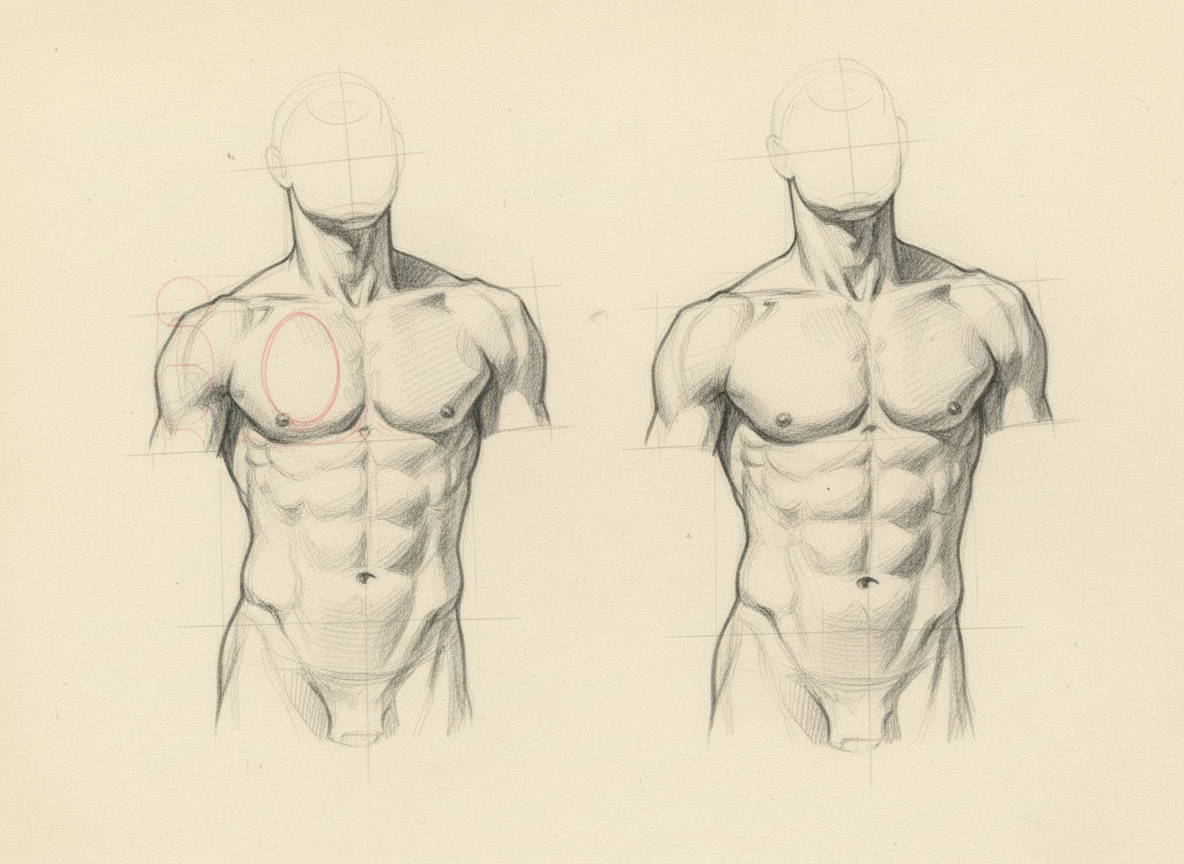
One of the most distinctive features of the lean male torso is the interleaving pattern where the serratus anterior and the external obliques meet on the side of the ribcage. The serratus anterior inserts into the ribs from behind (originating on the medial border of the scapula), while the external obliques originate from the same ribs from the front.
This creates a characteristic zigzag or finger-like pattern on the lateral surface of the torso — a series of alternating diagonal ridges that run from the armpit area downward toward the waist. This interleaving pattern is one of the most telling details in a figure drawing and immediately signals anatomical understanding.
How to Draw the Interleave
- Identify the lower border of the pectoralis major. The serratus-oblique interleave begins just below this line.
- Draw 3-4 diagonal slips of the serratus anterior, running from the ribs upward and backward toward the scapula.
- Between each serratus slip, draw the corresponding origin of the external oblique, running downward and forward.
- The pattern should look like interlocking fingers — not a smooth, continuous surface.
The Lateral Flow: Ribcage to Pelvis
The lateral contour of the male torso — from the armpit to the hip — is one of the most important lines in figure drawing. It defines the overall silhouette of the figure and communicates the relationship between the ribcage and pelvis.
In a standing pose with weight on one leg (contrapposto), the lateral contour on the weight-bearing side is compressed — the ribcage and pelvis are closer together, and the obliques bunch and fold. On the non-weight-bearing side, the contour is stretched — the ribcage and pelvis are further apart, and the obliques are elongated and smooth.
This asymmetry is essential for creating dynamic, convincing figure drawings. A torso with identical left and right contours looks stiff and lifeless.
Drawing the Obliques: Step by Step
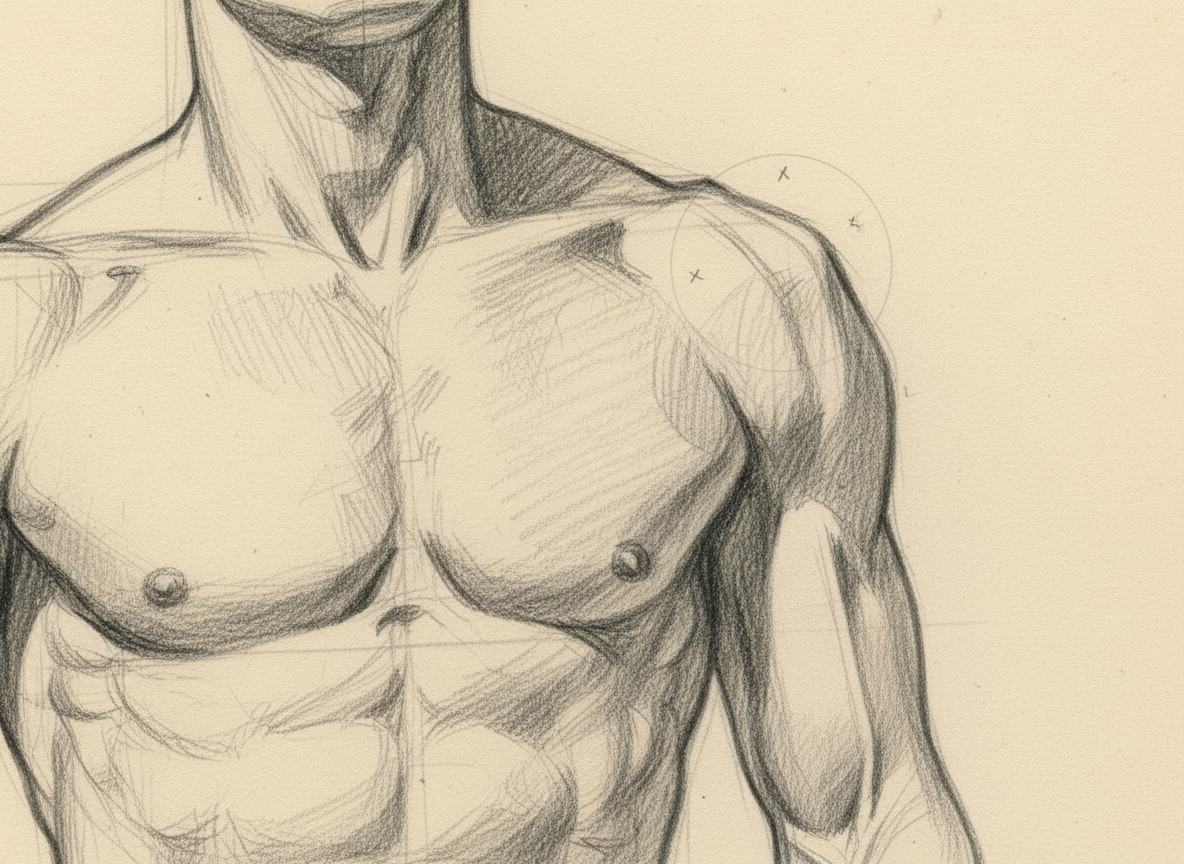
- Establish the ribcage and pelvis. Draw them as separate tilting masses. The angle between them determines the degree of compression and stretch on each side.
- Draw the lateral contour. On the compressed side, the contour curves inward sharply. On the stretched side, it flows outward in a gentle arc.
- Indicate the iliac crest. The top of the pelvis is the lower anchor point for the obliques. It is often visible as a bony ridge on the surface.
- Add the oblique surface forms. Draw the diagonal direction of the muscle fibres, running from the lower ribs downward and inward toward the groin.
- Add the serratus-oblique interleave. On the lateral surface of the ribcage, draw the alternating finger-like pattern of the serratus and oblique origins.
- Build tonal values. Use cross-hatching following the muscle fibre direction to model the forms. The obliques catch light differently on the compressed and stretched sides.
The Inguinal Ligament and the V-Line
At the base of the obliques, the inguinal ligament runs from the anterior superior iliac spine (the front point of the pelvis) to the pubic tubercle. This ligament creates the characteristic diagonal line — sometimes called the “V-line” — that separates the lower abdomen from the upper thigh.
In figure drawing, this line is one of the most important transitions in the torso. It marks the boundary between the torso and the leg, and its angle and depth communicate the tilt of the pelvis and the weight distribution of the pose.
Common Mistakes
- Drawing the waist as a straight line: The lateral contour of the torso is always curved. Even in a symmetrical standing pose, there is a subtle inward curve at the waist.
- Ignoring the serratus-oblique interleave: This is one of the most distinctive features of the male torso. Omitting it makes the lateral surface look flat and generic.
- Making both sides identical: In almost every pose, one side is compressed and the other is stretched. Draw the asymmetry.
- Forgetting the iliac crest: This bony landmark anchors the obliques and defines the lower boundary of the waist. It is often visible on the surface.
The Complete Path
The obliques and torso rhythm are covered in depth in my book Mastering the Male Figure, with dedicated lessons on lateral torso anatomy and dynamic pose construction. For the broader torso context, see my guides on male torso anatomy and drawing abdominal structure.