Classical male figure drawing is one of the most demanding and rewarding disciplines in the history of art. From the Renaissance ateliers of Florence to the academies of Paris, the study of the male figure has been the cornerstone of artistic training for five centuries.
In this guide, I will walk you through the complete atelier system as I have practised and refined it over 30 years — from the first gesture mark to a fully rendered, exhibition-quality drawing. This is not a simplified overview. It is the complete method.
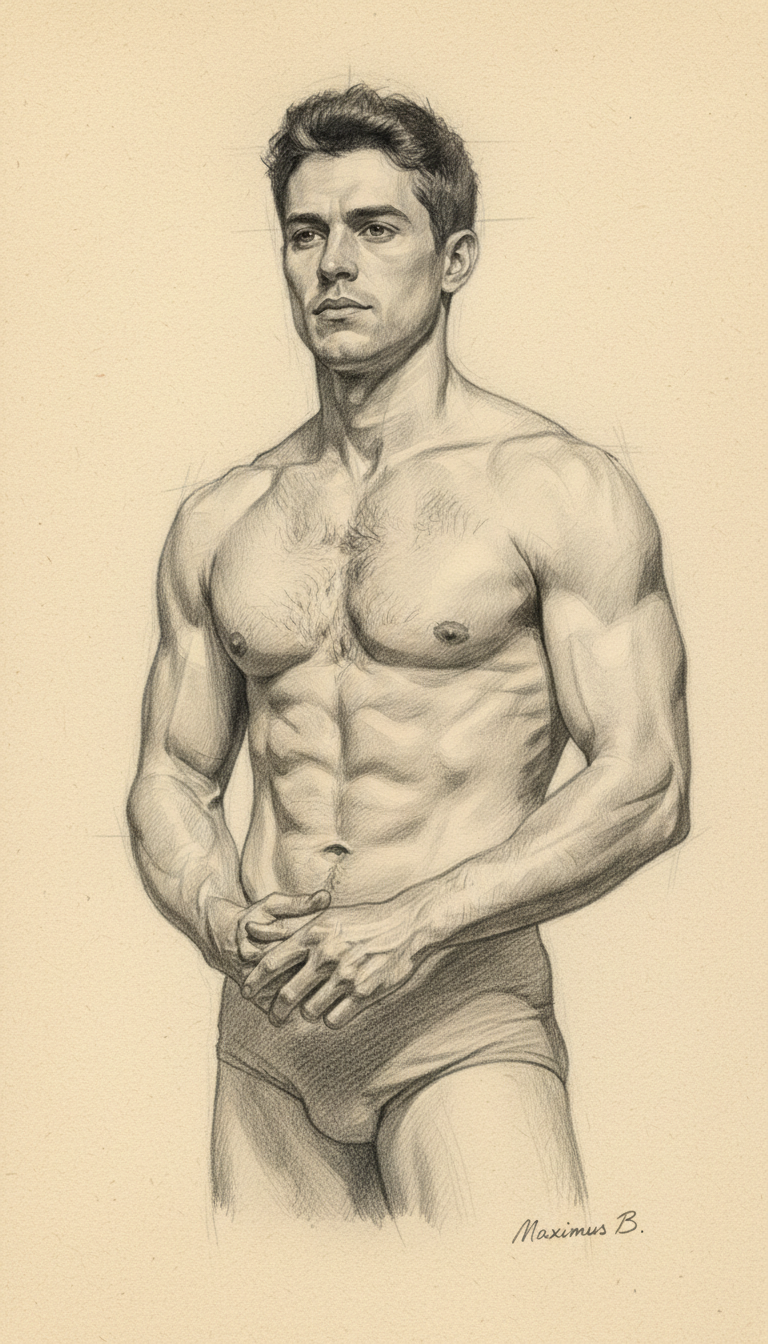
What Is the Atelier System?
The atelier system is a structured approach to teaching drawing that originated in the Renaissance workshops of Italy. The word atelier is French for “studio” or “workshop” — and the method it describes is one of progressive mastery, moving from simple to complex, from general to specific, from observation to expression.
The classical atelier curriculum follows a strict sequence: cast drawing first, then the figure from life, then composition and expression. Each stage builds on the last. Nothing is skipped. Nothing is rushed.
In my own practice, I have adapted this system for the independent artist working without a formal studio — but the principles remain unchanged. The sequence, the discipline, and the commitment to observation are the same.
Stage 1: Proportions & the Head Unit System
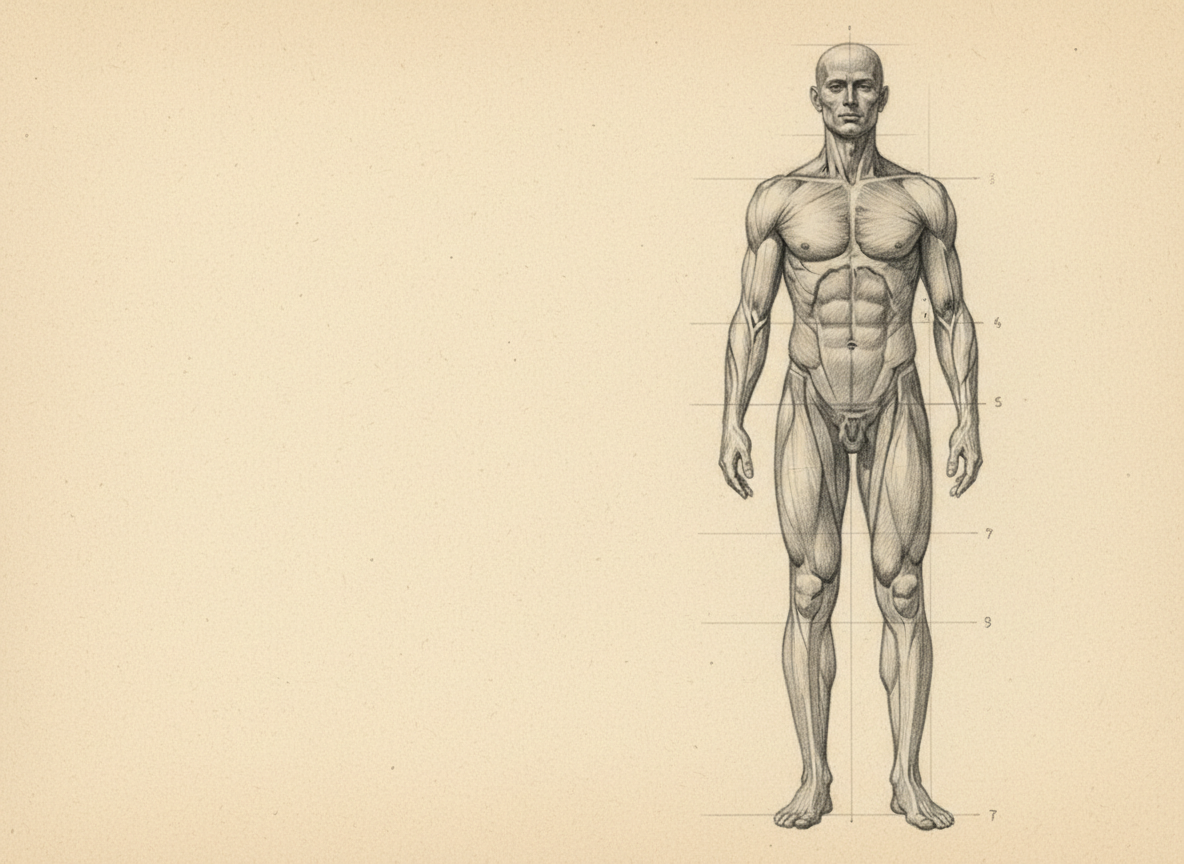
Every atelier drawing begins with proportion. Before a single anatomical detail is added, the overall dimensions of the figure must be established with precision. The classical tool for this is the head unit system — a method used by artists since the Renaissance.
The ideal male figure stands approximately 7.5 to 8 heads tall. The halfway point of the body falls at the pubic bone — not the waist, as many beginners assume. The shoulders are approximately 2 heads wide. The distance from the chin to the nipple line is one head unit.

Memorise the head unit breakdown. Draw it from memory every day until it becomes instinct. This framework will anchor every figure you draw for the rest of your artistic life.
- Head 1: Top of skull to chin
- Head 2: Chin to nipple line
- Head 3: Nipple line to navel
- Head 4: Navel to pubic bone (halfway point)
- Heads 5–8: Pubic bone to soles of feet
Stage 2: Gesture — The Life of the Drawing
Gesture is the first mark on the paper and the most important. It captures the overall movement, weight, and rhythm of the pose — the living energy of the figure before any anatomical detail is considered.
In the atelier tradition, gesture drawing is practised relentlessly. Short poses of 30 seconds to 2 minutes force the artist to identify the essential movement immediately, without the luxury of refinement.

The gesture line flows from the head, through the spine, through the pelvis, and down through the weight-bearing leg. It is a single, continuous movement — not a collection of separate parts.
Do not worry about accuracy at the gesture stage. Worry about energy. A technically perfect drawing without gesture looks dead. A gesture-driven drawing with imperfect anatomy looks alive.
Gesture Practice Protocol
- Begin every drawing session with 10–15 gesture sketches of 30–60 seconds each.
- Use long, sweeping lines. Do not lift the pencil unnecessarily.
- Focus on the spine line and the tilt of the shoulders and pelvis.
- Do not erase. Move on. The next gesture will be better.
Stage 3: Anatomy — Structure Beneath the Surface
Anatomy is the skeleton of figure drawing. Without it, the surface forms have no logic, no consistency, and no convincing three-dimensionality. With it, every shadow, every contour, and every highlight has a reason.
The atelier approach to anatomy is not memorisation of muscle names — it is the understanding of how underlying structures create visible surface forms. You are not drawing muscles; you are drawing the shapes that muscles create on the surface of the skin.

The key muscle groups to master for the male figure, in order of priority:
- Trapezius and deltoid — define the shoulder silhouette
- Pectoralis major — the dominant chest mass
- Rectus abdominis and external obliques — the core surface texture
- Latissimus dorsi — the back taper
- Gluteus maximus and quadriceps — the lower body mass
- Gastrocnemius — the calf form
Study each muscle group in isolation before integrating them into full figure drawings. Draw the muscle from memory, then check against reference. Repeat until the form is internalised.
Stage 4: Tonal Values — Light Reveals Form
Tonal values are how we translate three-dimensional form onto a two-dimensional surface. Without tonal control, a drawing is flat. With it, the figure appears to exist in real space, with real volume and real light.
In the classical atelier tradition, tonal values are built gradually — from light to dark, from general to specific. The process is additive: you begin with the lightest values and layer progressively darker tones on top.

The Five Tonal Zones
Every surface in a figure drawing can be assigned to one of five tonal zones:
- Highlight — the brightest point where light strikes directly
- Light — the general lit area, slightly darker than the highlight
- Halftone — the transition zone between light and shadow
- Core shadow — the darkest area, where the form turns away from the light
- Reflected light — a subtle lightening within the shadow, caused by light bouncing from nearby surfaces
Identify these five zones on every form before you begin shading. Map them lightly with your HB pencil. Then build your tones systematically from light to dark.
Cross-Hatching for Classical Tonal Building
The classical technique for building tone in graphite is cross-hatching — layers of parallel lines drawn at different angles. Each layer adds depth without destroying the texture of the paper or the visibility of individual pencil strokes.
Your hatching lines should always follow the form of the surface you are shading. On a rounded deltoid, the lines curve. On the flat plane of the sternum, they run straight. The direction of your strokes is as important as their density.
Stage 5: Edges — The Language of Form
Edges are one of the most overlooked elements in figure drawing — and one of the most powerful. The quality of an edge communicates the speed of a surface transition, the hardness or softness of a form, and the depth of space between objects.
In the classical tradition, edges are classified into four types: hard, firm, soft, and lost. Mastering the use of all four is what separates a competent drawing from a truly expressive one.

The Four Edge Types
- Hard edges — sharp, clear transitions. Use where a form turns abruptly or where a lit surface meets a dark background. Use sparingly — too many hard edges make a drawing look mechanical.
- Firm edges — clear but not sharp. The most common edge type in figure drawing. Used for most contours and internal form transitions.
- Soft edges — gradual transitions. Use where forms curve gently, where muscles overlap softly, or where shadow fades into halftone.
- Lost edges — the edge disappears entirely. Use where two surfaces of similar value meet, or where a form recedes into shadow. Lost edges create depth and atmospheric space.
A drawing with only hard edges looks flat and graphic. A drawing with only soft edges looks blurry and formless. The mastery is in the variation — knowing which edge type serves each specific moment in the drawing.
Stage 6: Finishing — The Final 10%
The finishing stage is where a drawing moves from competent to exceptional. It is the final 10% of the work — but it accounts for 50% of the visual impact. This is where the deepest darks are placed, the sharpest highlights are lifted, and the most expressive edges are refined.
In the atelier tradition, finishing is never rushed. You step back from the drawing repeatedly, assessing the overall tonal balance before making any final marks. A premature dark accent can destroy the tonal harmony of an entire drawing.
The Finishing Checklist
- Check tonal range: Is there a true white (the paper) and a true dark (your deepest 6B)? If not, the drawing lacks contrast.
- Check the focal point: The area of highest contrast should be where you want the viewer's eye to rest first — typically the face or the most expressive gesture.
- Check edge variety: Are there hard, firm, soft, and lost edges throughout? Or is everything the same?
- Check the gesture: Does the finished drawing still carry the energy of the original gesture sketch? If the figure looks stiff, the gesture has been lost.
- Add the signature: The final mark. Place it where it completes the composition without competing with the drawing.
The Complete Path
The classical atelier system is not a shortcut. It is a long, demanding, deeply rewarding path. But it is a path — a structured progression from beginner to master that has been proven over five centuries of artistic tradition.
My book Mastering the Male Figure is built on exactly this system — 60 progressive lessons across 6 stages of increasing complexity, from first gesture marks to exhibition-quality finished drawings. It is the structured atelier curriculum I wish had existed when I started.
For a complete foundation, begin with my beginner's guide to drawing the male figure, and continue with the graphite pencil techniques guide for a deep dive into the materials and methods.