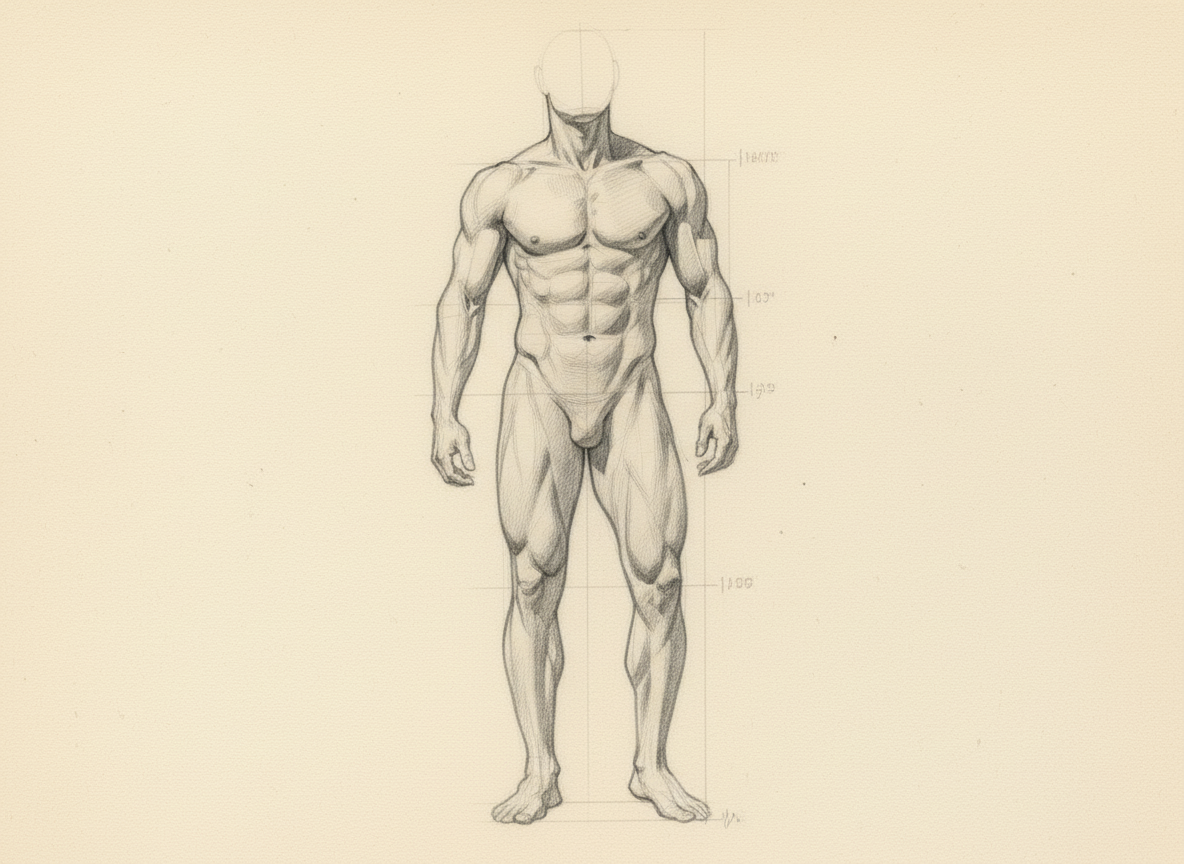
Drawing the male figure is one of the most rewarding — and demanding — skills an artist can develop. Whether you are a complete beginner picking up a pencil for the first time, or a practising artist looking to sharpen your understanding of masculine anatomy, this guide will give you a clear, structured foundation to build on.
Over 30 years of drawing the male figure, I have refined a process that works. It is not complicated, but it requires patience, observation, and consistent practice. Everything in this article is drawn from real experience — not theory alone.
Why the Male Figure Is Different
The male figure presents unique challenges compared to the female form. Broader shoulders, a narrower pelvis, more angular musculature, and a generally more geometric underlying structure all demand a different approach to proportion and shading.
Understanding these differences is not optional — it is the foundation of convincing figure drawing. The male torso alone contains some of the most complex anatomical relationships in the human body: the interplay between the pectorals, the deltoids, the external obliques, and the rectus abdominis creates a landscape of overlapping forms that must be understood in three dimensions.
The Head Unit System: Your Measuring Tool
The single most important concept for any beginner is the head unit system. This classical method, used by artists since the Renaissance, uses the height of the head as a standard unit of measurement for the entire body.
The ideal male figure stands approximately 7.5 to 8 heads tall. Here is the breakdown:
- Head 1: Top of the skull to the chin
- Head 2: Chin to the nipple line (mid-chest)
- Head 3: Nipple line to the navel
- Head 4: Navel to the pubic bone (the halfway point of the body)
- Head 5: Pubic bone to mid-thigh
- Head 6: Mid-thigh to just below the knee
- Head 7: Below the knee to mid-shin
- Head 7.5–8: Mid-shin to the soles of the feet
Memorise this. Draw it from memory. Test yourself. This framework will anchor every figure you draw for the rest of your life.
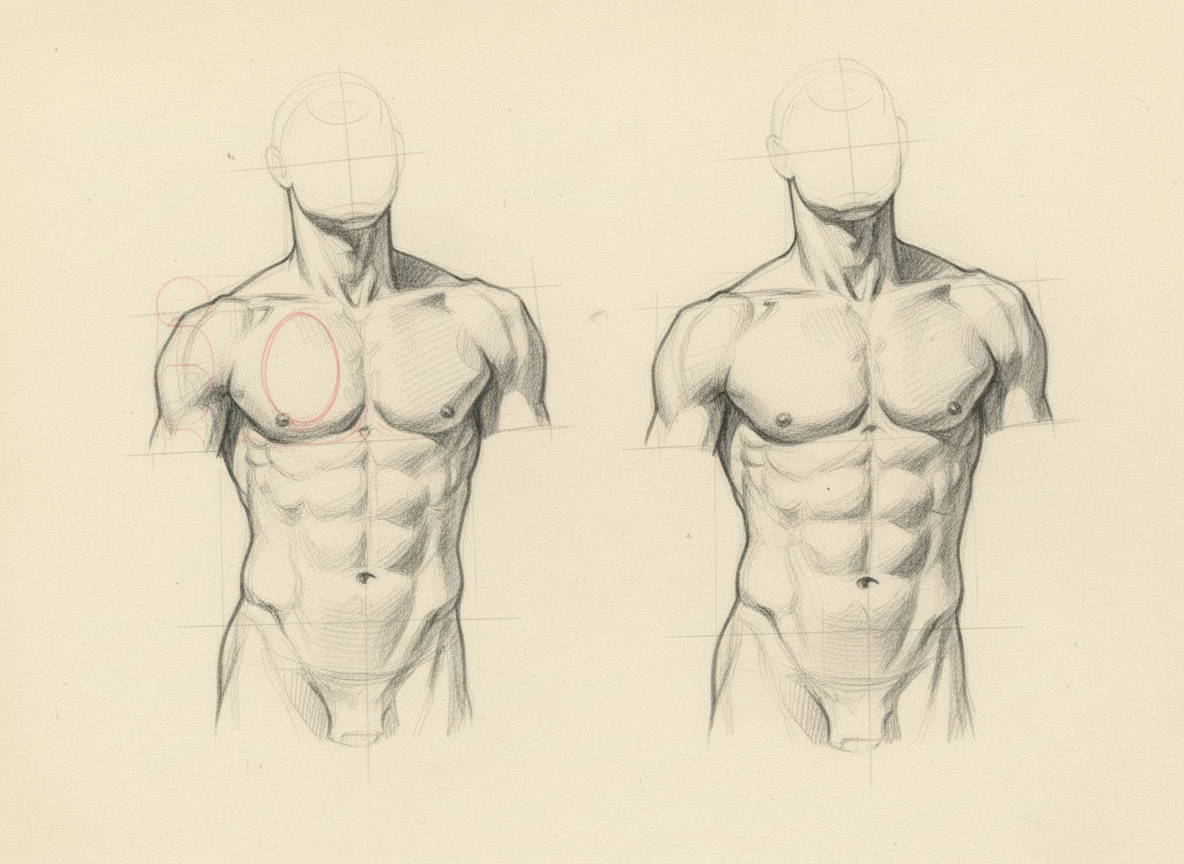
Key Anatomical Landmarks to Learn First
Before you attempt a full figure, learn to identify and place these landmarks accurately. They are the skeleton of every convincing drawing:
- The clavicles (collarbones): These define the width and angle of the shoulders. In the male figure, they are broader and more prominent.
- The acromion process: The bony point at the top of each shoulder. This is where the deltoid muscle originates.
- The sternum: The central bone of the chest. It anchors the rib cage and defines the vertical centre line of the torso.
- The iliac crest: The top edge of the pelvis. In males, this sits lower and narrower than in females.
- The great trochanter: The bony protrusion at the top of the femur. This defines the widest point of the hips in the male figure.
- The patella (kneecap): A critical landmark for getting leg proportions right.
Starting Your Drawing: Gesture First
Never begin a figure drawing with details. Always start with gesture — a quick, flowing line that captures the overall movement, weight, and rhythm of the pose. Gesture is the life of the drawing. Without it, even the most anatomically accurate figure will look stiff and lifeless.
Spend 30 seconds to 2 minutes on your gesture sketch. Use long, sweeping lines. Do not worry about accuracy — worry about energy. The gesture line should flow from the head, through the spine, through the pelvis, and down through the weight-bearing leg.
Building Structure Over Gesture
Once your gesture is established, begin layering structure on top. Use simple geometric forms:
- Rib cage: An egg shape, slightly compressed and tilted
- Pelvis: A simplified bucket or wedge shape
- Limbs: Cylinders that taper toward the joints
- Joints: Small spheres at the shoulders, elbows, wrists, knees, and ankles
This construction phase is where proportion errors are caught and corrected. Check your head units. Compare the width of the shoulders to the width of the pelvis. Verify that the halfway point of the figure falls at the pubic bone.
Adding Anatomical Detail
With gesture and structure in place, you can begin refining anatomical forms. Work from large shapes to small. Define the major muscle groups first — the pectorals, the deltoids, the latissimus dorsi, the quadriceps — before moving to smaller details like the serratus anterior or the tendons of the forearm.
A common mistake is to jump straight to surface detail before the underlying structure is solid. Resist this temptation. The surface only looks right when the structure beneath it is correct.
Shading and Tonal Values
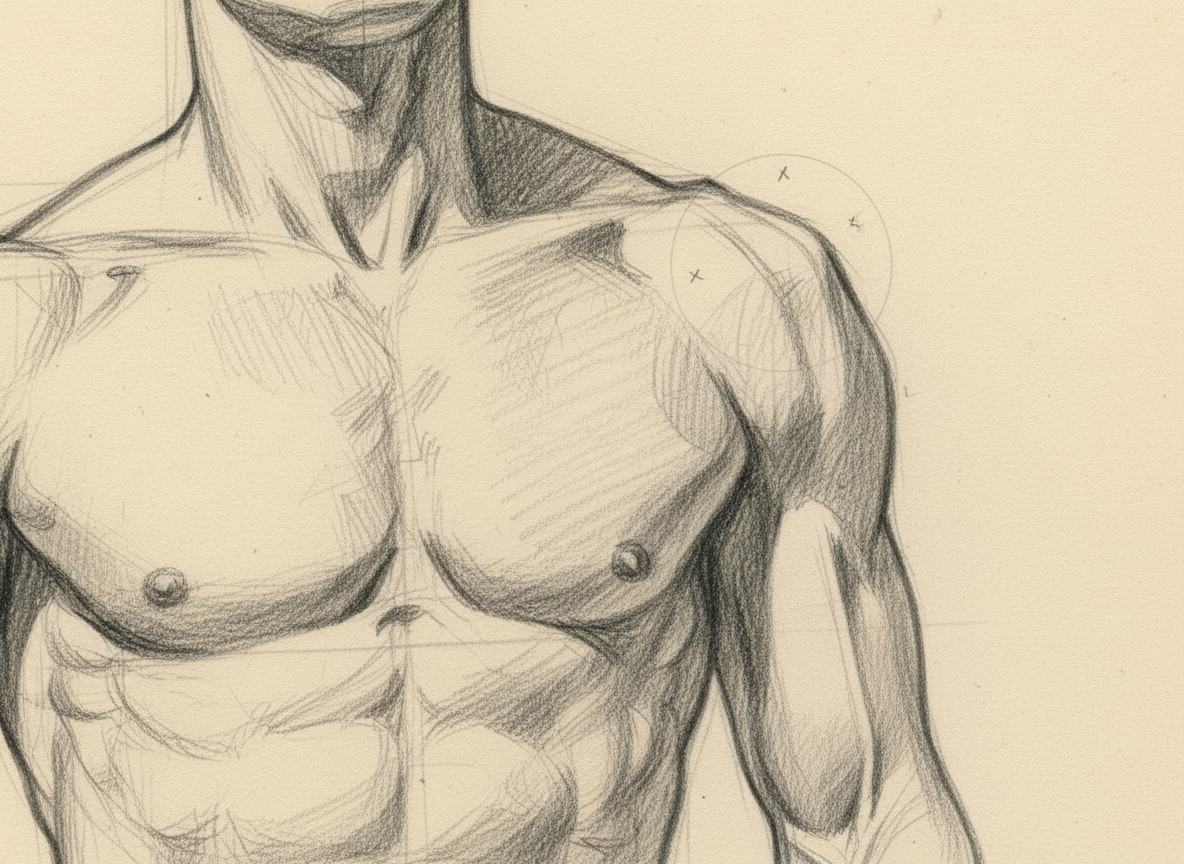
Shading brings your figure drawing to life. For graphite pencil work, I recommend building tone gradually using cross-hatching and layered strokes rather than blending alone. This preserves the hand-drawn quality and gives the drawing texture and depth.
Start with your lightest values and build toward the darks. Identify the light source direction and commit to it. Every shadow, every highlight, every halftone must be consistent with that single light source.
For a deeper dive into pencil technique, read my guide on graphite pencil techniques for realistic figure drawing.
Practice Exercises for Beginners
Here are five exercises I recommend for anyone starting their figure drawing journey:
- 100 gesture drawings: Draw 100 two-minute gesture sketches from reference. Focus on flow, not accuracy.
- Head unit drills: Draw 10 standing figures using only the head unit system. No reference — just proportions from memory.
- Landmark mapping: On a simple figure outline, mark all six key landmarks listed above. Repeat until you can place them without thinking.
- Torso studies: Draw 20 male torsos from different angles. Focus on the relationship between the rib cage and pelvis.
- One long study per week: Spend 2–3 hours on a single figure drawing. Apply everything: gesture, structure, anatomy, shading.
Common Pitfalls to Avoid
I have written a dedicated article on the 7 most common figure drawing mistakes, but here are the top three for beginners:
- Starting with details: Always work from large to small, general to specific.
- Ignoring gesture: A technically perfect drawing without gesture looks dead.
- Fear of dark values: Beginners often shade too lightly. Commit to your darks — they create the contrast that makes a drawing read.
Where to Go from Here
This guide covers the essentials, but mastering the male figure is a lifelong pursuit. If you want a structured, step-by-step course that takes you from first lines to finished detail, my book Mastering the Male Figure covers everything in this article and far more — with 60 progressive lessons, master drawings to study, and practice pages for every stage.
For recommended study materials, see my curated list of the best figure drawing books of all time.