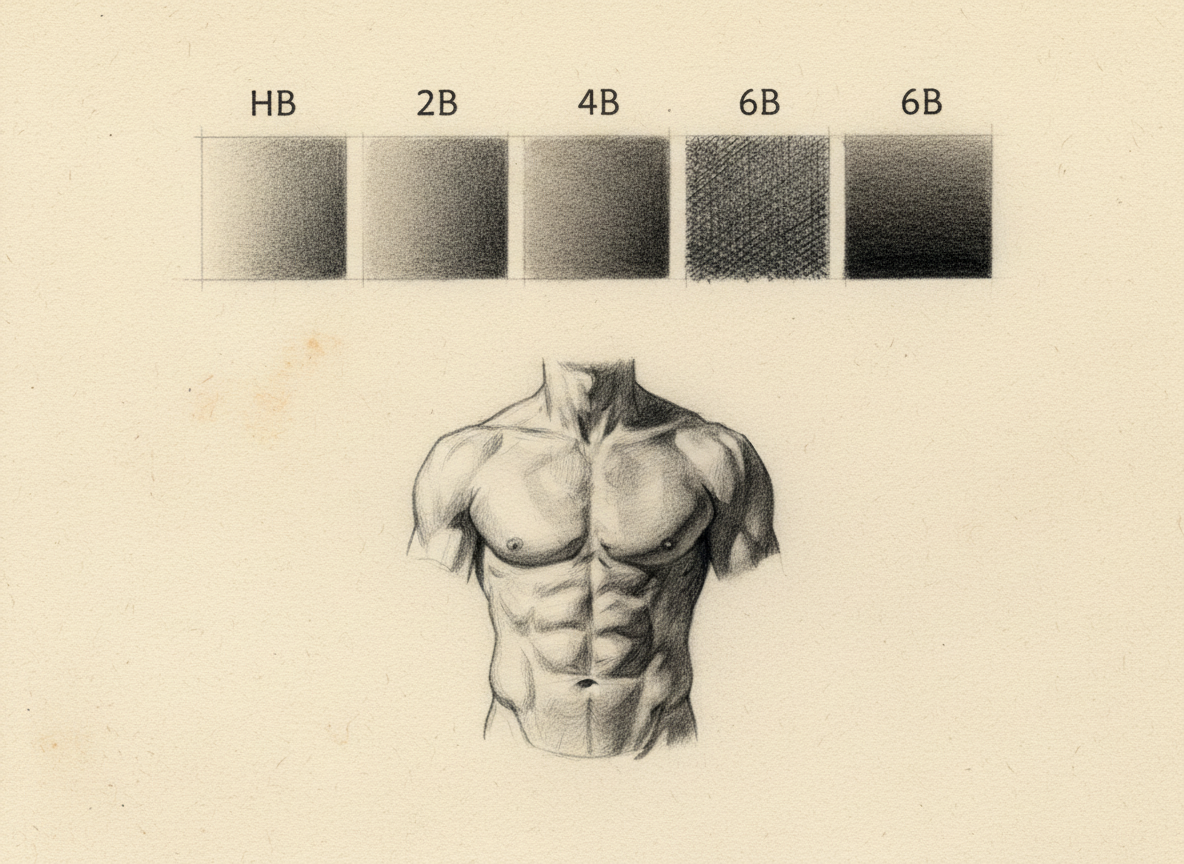
The pencil is the most intimate drawing tool. Unlike charcoal or digital media, graphite rewards patience, precision, and a deep understanding of tonal values. Over 30 years of figure drawing, I have refined my approach to graphite pencil technique — and in this guide, I will share everything I have learned about using pencils from HB to 6B to produce classical, atelier-quality male figure drawings.
Understanding Pencil Grades
Graphite pencils are graded on a scale from hard (H) to soft (B). For figure drawing, you need a range that covers light construction lines through to deep, rich shadows. Here is the range I use and recommend:
- HB: The workhorse. Use for initial construction lines, gesture marks, and the lightest tonal values. HB lines are easy to erase and refine.
- 2B: Your primary shading pencil. Produces smooth, medium-value tones ideal for building the first layers of shadow and halftone.
- 4B: For deeper shadows and stronger cross-hatching. 4B has enough softness to create rich darks without excessive pressure.
- 6B: Reserved for the darkest accents — the deepest shadows, the sharpest contrasts, and the final touches that give a drawing its punch. Use sparingly.
You do not need every grade in between. These four pencils cover the full tonal range required for classical figure drawing.
Cross-Hatching: The Foundation of Classical Shading
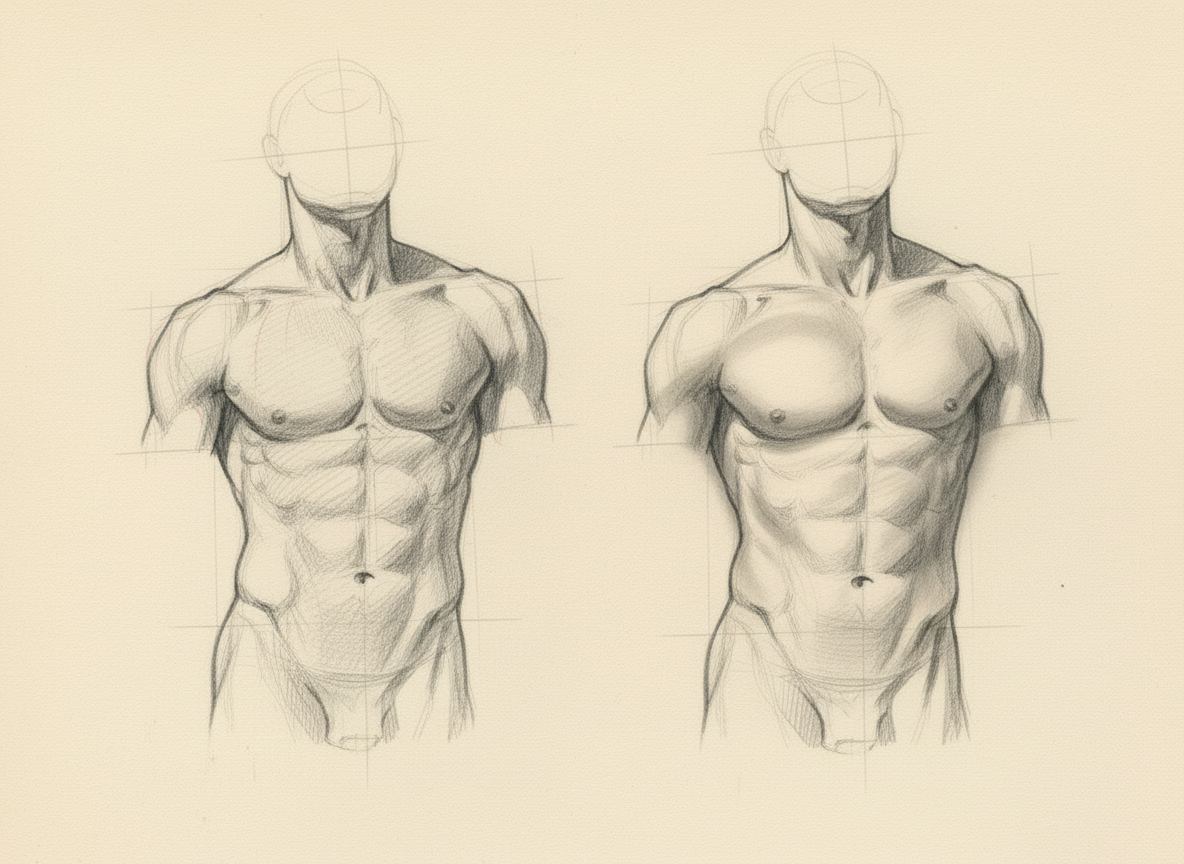
Cross-hatching is the technique of building tone through layers of parallel lines drawn in different directions. It is the backbone of classical graphite figure drawing and produces a quality of shading that blending alone cannot achieve.
The principle is simple: one layer of parallel lines creates a light tone. A second layer, drawn at an angle to the first, darkens the area. A third layer darkens it further. By controlling the spacing, pressure, and angle of each layer, you can create an infinite range of tonal values.
Cross-Hatching Rules for Figure Drawing
- Follow the form: Your hatching lines should follow the contour of the muscle or body part you are shading. On a rounded deltoid, the lines curve. On a flat plane like the sternum, they run straight.
- Vary the spacing: Closer lines create darker tones. Wider spacing creates lighter tones. Use this to model the gradual transition from light to shadow.
- Build gradually: Start with light, widely spaced lines. Add layers only where you need darker values. It is always easier to darken than to lighten.
- Rotate your angles: Each new layer of hatching should be at a different angle — typically 30 to 45 degrees from the previous layer. This prevents a mechanical, grid-like appearance.
Tonal Layering: Building Depth
Tonal layering is the process of building up graphite in thin, transparent layers to create smooth, luminous tonal transitions. Unlike heavy-handed shading, layering preserves the texture of the paper and the visibility of individual pencil strokes — both of which are essential to the hand-drawn quality of classical figure drawing.
The process:
- Begin with HB for the lightest shadow areas. Use light pressure and even strokes.
- Switch to 2B and add a second layer over the mid-tone areas. Do not press harder — let the softer graphite do the work.
- Use 4B for the core shadows — the darkest areas where the form turns away from the light.
- Reserve 6B for the very deepest accents: the underside of the jaw, the crease of the armpit, the space between overlapping forms.
Blending: When and How
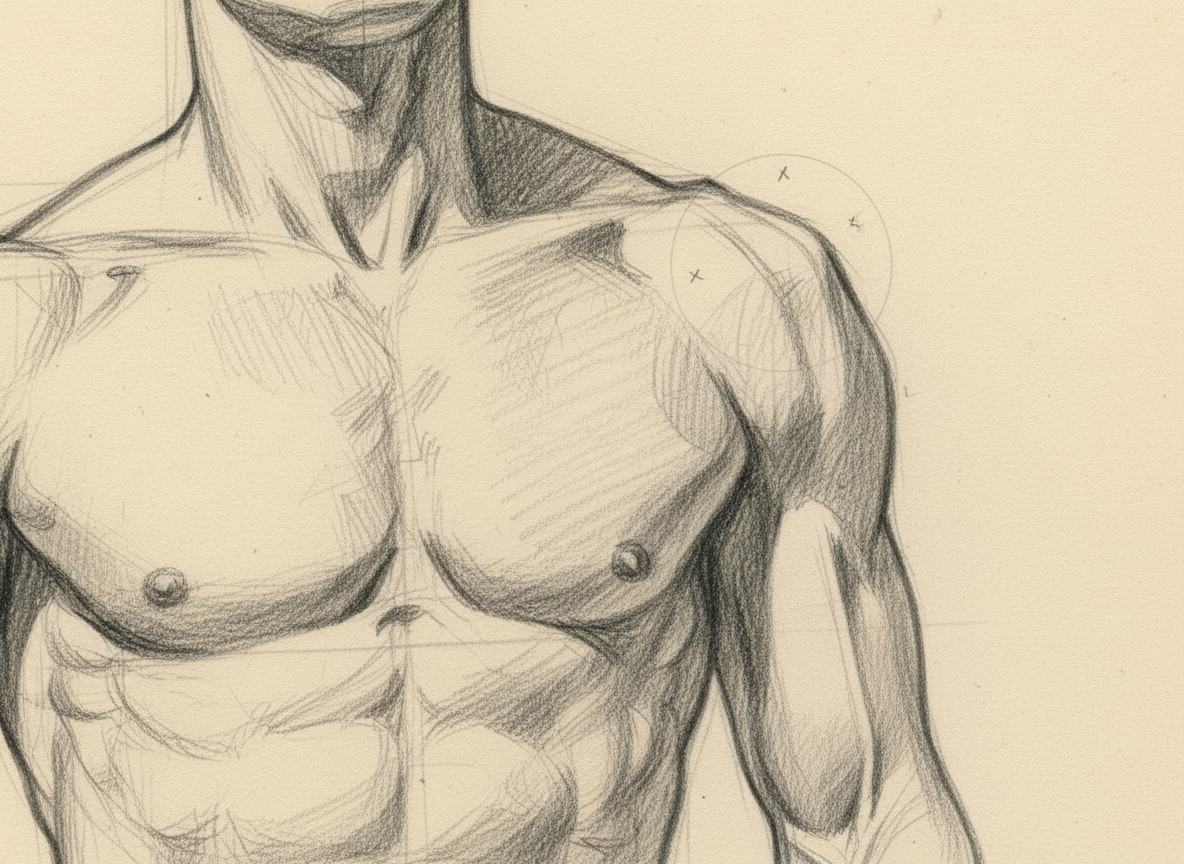
Blending has its place in figure drawing, but it should be used with restraint. Over-blending destroys the pencil strokes that give a drawing its character and makes the result look photographic rather than hand-drawn.
When to blend: Use a blending stump (tortillon) for soft transitions in large shadow areas — the side of the torso, the inner thigh, the underside of the forearm. Blend in the direction of the form, not randomly.
When not to blend: Never blend highlights, sharp edges, or areas where you want visible pencil texture. The contrast between blended shadows and crisp, hatched light areas is what gives a drawing depth and visual interest.
The Kneaded Eraser as a Drawing Tool
A kneaded eraser is not just for correcting mistakes — it is an active drawing tool. By pressing it gently against the paper, you can lift graphite to create highlights, soften edges, and add subtle tonal variation.
- Lifting highlights: Shape the eraser to a point and press it against areas where you want bright highlights — the top of the shoulder, the bridge of the nose, the crest of the pectoral.
- Softening edges: Gently dab the eraser along a hard edge to create a softer, more natural transition.
- Creating texture: Press the eraser lightly across a shaded area to create the appearance of skin texture or fabric.
Paper Choice Matters
The paper you draw on has a profound effect on the final result. For classical figure drawing in graphite, I recommend a medium-tooth, warm-toned paper. The tooth (texture) of the paper catches the graphite and creates the visible grain that is characteristic of hand-drawn work.
Avoid ultra-smooth papers — they produce a slick, digital-looking result. Avoid very rough papers — they break up the graphite too much and make fine detail difficult.
Putting It All Together
The best way to develop your pencil technique is to apply it to real figure drawing. Start with a gesture and construction foundation, then layer your tonal work on top using the techniques described here.
Avoid the common mistakes that undermine good technique — particularly flat shading and inconsistent light sources.
For a complete, structured course that integrates all of these techniques into progressive lessons, my book Mastering the Male Figure covers pencil technique in depth alongside anatomy, proportion, and artistic expression.