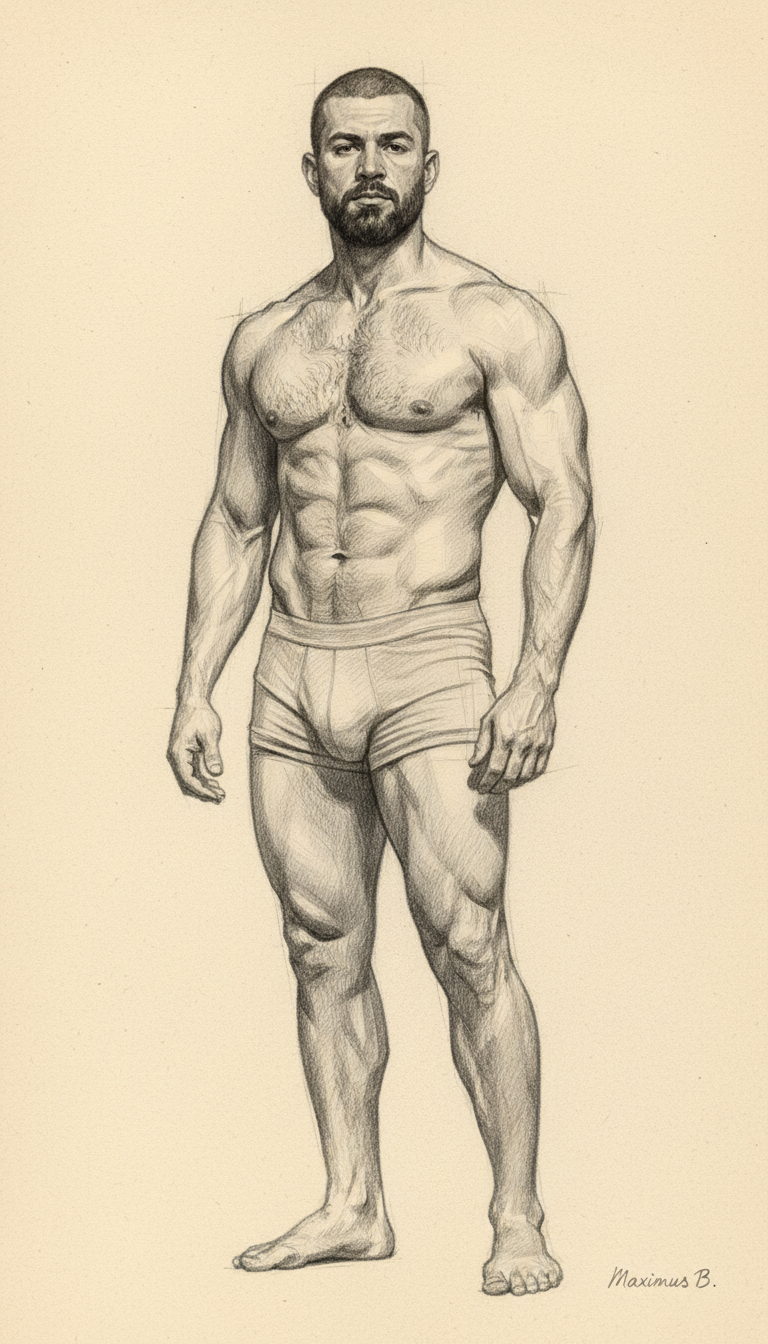
If there is one concept that separates flat, unconvincing figure drawings from those that feel solid and real, it is the understanding of core shadow and reflected light. These two elements — working together — are what give a graphite figure drawing its sense of volume, weight, and presence on the page.
In this lesson, I will show you how to identify, place, and render core shadow and reflected light in your male figure drawings, using the same classical graphite approach I have refined over 30 years of practice.
Why Core Shadow and Reflected Light Matter in Figure Drawing
Every three-dimensional form that receives light produces a predictable pattern of tonal zones. Understanding this pattern is not optional — it is the foundation of all convincing tonal drawing. Without it, your shading is guesswork. With it, every shadow you place has a reason, and every highlight has a purpose.
The core shadow is the darkest band of shadow on a form — the precise line where the surface turns away from the light source. It is not the cast shadow (which falls on another surface), and it is not the general shadow area. It is a specific, narrow zone of maximum darkness that defines the turning point of the form.
Reflected light is the subtle illumination that appears within the shadow side of a form, caused by light bouncing off nearby surfaces. It is always softer and darker than the lit side — but its presence is what prevents shadows from looking like flat, dead areas of black.
The Common Mistake Artists Make
The most frequent error is making reflected light too bright. When reflected light approaches the value of the lit side, the form appears to flatten or even invert — the viewer's eye reads the reflected light as a second light source, and the three-dimensional illusion collapses.
The second mistake is omitting reflected light entirely. Without it, the shadow side of the figure becomes a uniform dark mass with no internal structure. Real shadows are never uniform — they contain subtle tonal variation that reveals the form even in the darkest areas.
The third mistake is placing the core shadow in the wrong location. The core shadow sits at the exact point where the form turns away from the light. On a cylindrical form like the upper arm, this is a narrow band running along the edge of the turning surface. On a more complex form like the torso, it follows the contours of the underlying anatomy.
The Five Tonal Zones
Before you can render core shadow and reflected light correctly, you need to understand the complete tonal structure of a lit form. Every surface in your figure drawing can be assigned to one of five zones:
- Highlight — the brightest point where light strikes the surface most directly. On a graphite drawing, this is the bare paper.
- Light — the general lit area, slightly darker than the highlight. Rendered with the lightest pencil strokes (HB).
- Halftone — the transitional zone between light and shadow. This is where the form begins to turn away from the light. Rendered with 2B.
- Core shadow — the darkest band, sitting at the turning point of the form. Rendered with 4B to 6B.
- Reflected light — a subtle lightening within the shadow, caused by light bouncing from nearby surfaces. Always darker than the halftone. Rendered by lifting slightly with a kneaded eraser or by leaving the area slightly lighter during the shading process.
The Maximus Method Approach
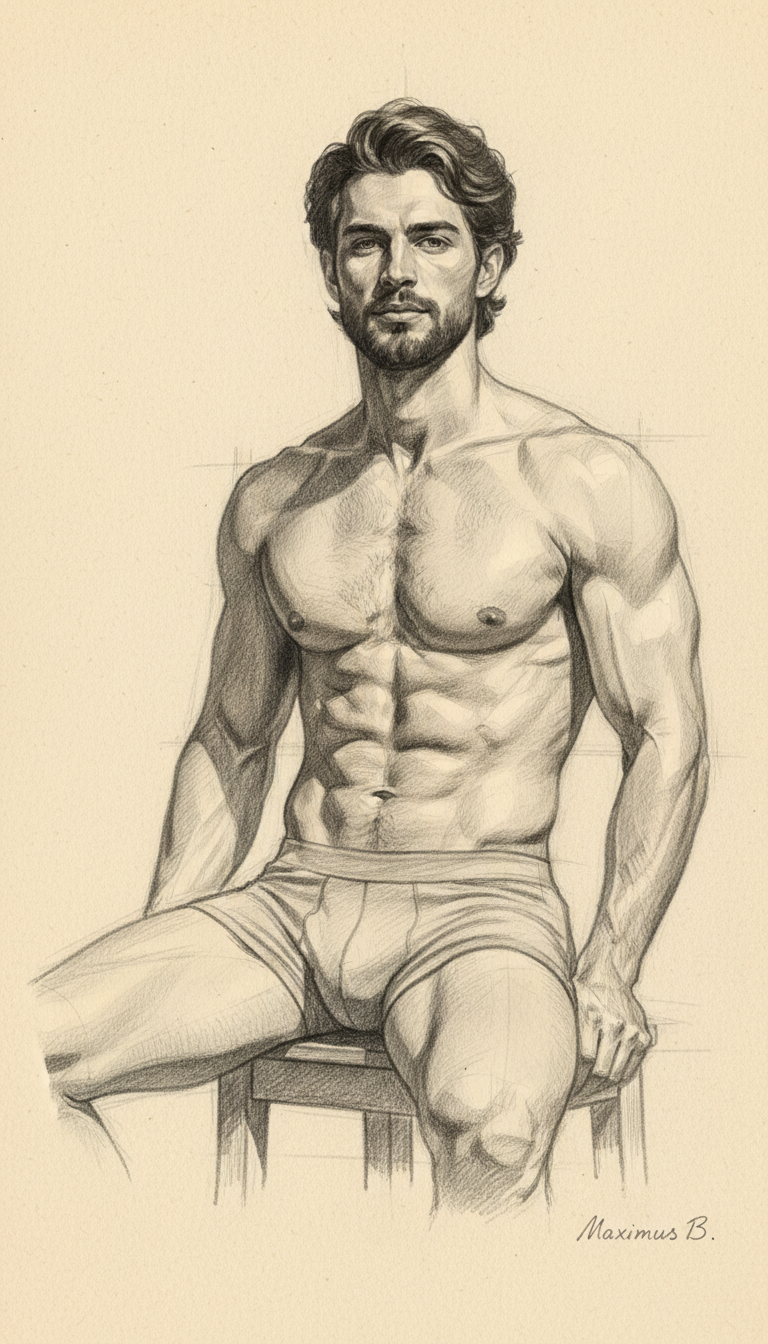
In the Maximus Method, light and shadow are never applied as an afterthought. They are built into the drawing from the earliest stages:
- Structure first. Establish the ribcage, pelvis, and limb construction. Identify the light source direction and commit to it.
- Map the shadow shapes. Before any tonal work, lightly outline the boundary between light and shadow on every major form. This boundary line is where your core shadow will sit.
- Block in the shadow mass. Fill the entire shadow side with a uniform mid-tone using 2B. Do not differentiate yet — just separate light from shadow.
- Darken the core shadow. Using 4B or 6B, deepen the narrow band at the turning point of each form. On the torso, this follows the lateral contour where the ribcage turns from front to side. On the arm, it runs along the edge of the bicep or tricep.
- Preserve the reflected light. Within the shadow mass, leave a subtle strip slightly lighter than the core shadow. This is the reflected light. It should be visible but never as bright as the halftone on the lit side.
How to Practise This
Set up a simple exercise using a single cylindrical form — a paper towel roll or a tin can — lit by a single desk lamp from one side, with a white card placed on the opposite side to bounce light back into the shadow.
- Draw the cylinder and identify all five tonal zones by observation.
- Render the cylinder in graphite, paying particular attention to the core shadow band and the reflected light strip.
- Now apply the same observation to a male torso reference. Identify where the core shadow falls on the pectorals, the deltoids, and the lateral torso.
- Draw the torso, mapping the shadow boundary first, then building the core shadow and reflected light using the same layered approach.
- Compare your drawing to the reference. Is the reflected light too bright? Is the core shadow in the correct position? Adjust and repeat.
Where Core Shadow and Reflected Light Appear on the Male Figure
On the male torso, the most prominent core shadows appear:
- Along the lateral contour of the ribcage — where the front plane of the torso turns into the side plane. This is often the most dramatic core shadow on the figure.
- Under the pectorals — where the chest mass curves under and the surface turns away from overhead light.
- On the deltoids — the rounded shoulder muscle produces a clear core shadow band as it curves from front to side.
- Along the inner arm — the bicep and tricep create opposing core shadows depending on the arm position.
- At the oblique-iliac crest junction — the transition from torso to pelvis often catches a strong core shadow, especially in contrapposto poses.
Reflected light is most visible in the concave areas of the figure — the armpit, the inner elbow, the space between the ribcage and the arm, and the underside of the jaw. These are areas where light bounces between two nearby surfaces.
Final Thought
Core shadow and reflected light are not decorative effects. They are the visual language of three-dimensional form. When you place them correctly, the figure appears to exist in real space. When you get them wrong, the drawing looks flat regardless of how accurate the anatomy is.
Train your eye to see these tonal zones on every form you encounter — not just on the figure, but on every object in your environment. The more you observe, the more naturally these relationships will appear in your drawings.
Follow Maximus B. and explore Mastering the Male Figure for a complete graphite atelier approach to structure, anatomy, light and rendering.