The male torso is the most complex and rewarding subject in figure drawing. It is where anatomy, proportion, and artistic expression converge — where the interplay of muscle groups, skeletal landmarks, and surface form creates the visual language of masculine structure.
In this guide, I will take you through the three foundational elements of the male torso: the ribcage, the shoulders, and the core. Understanding these three structures — and how they relate to each other — is the key to drawing the torso convincingly from any angle.
This is not a simplified overview. It is the anatomical knowledge I have built over 30 years of drawing the male figure, distilled into a practical guide for artists who want to understand what they are drawing, not just copy what they see.
Why the Torso Is the Foundation of Everything
Every figure drawing begins with the torso. Before you can convincingly draw the arms, legs, or head, you need a solid understanding of the central mass — the ribcage and pelvis — and how they connect, tilt, and twist relative to each other.
The torso is not a single rigid block. It is two separate masses — the ribcage above and the pelvis below — connected by the flexible lumbar spine. In almost every pose, these two masses tilt and rotate in different directions, creating the characteristic S-curve of the spine and the dynamic rhythm of the male figure.
This is the first and most important concept to understand. If you draw the torso as a single rigid form, your figures will always look stiff and unconvincing. Once you understand the ribcage-pelvis relationship, your figures will immediately gain life and movement.
The Ribcage: Structure and Form
The ribcage is the dominant mass of the upper torso. In the male figure, it is broader, deeper, and more barrel-shaped than in the female figure. Understanding its three-dimensional form is essential for drawing the torso convincingly from any angle.
The Basic Shape
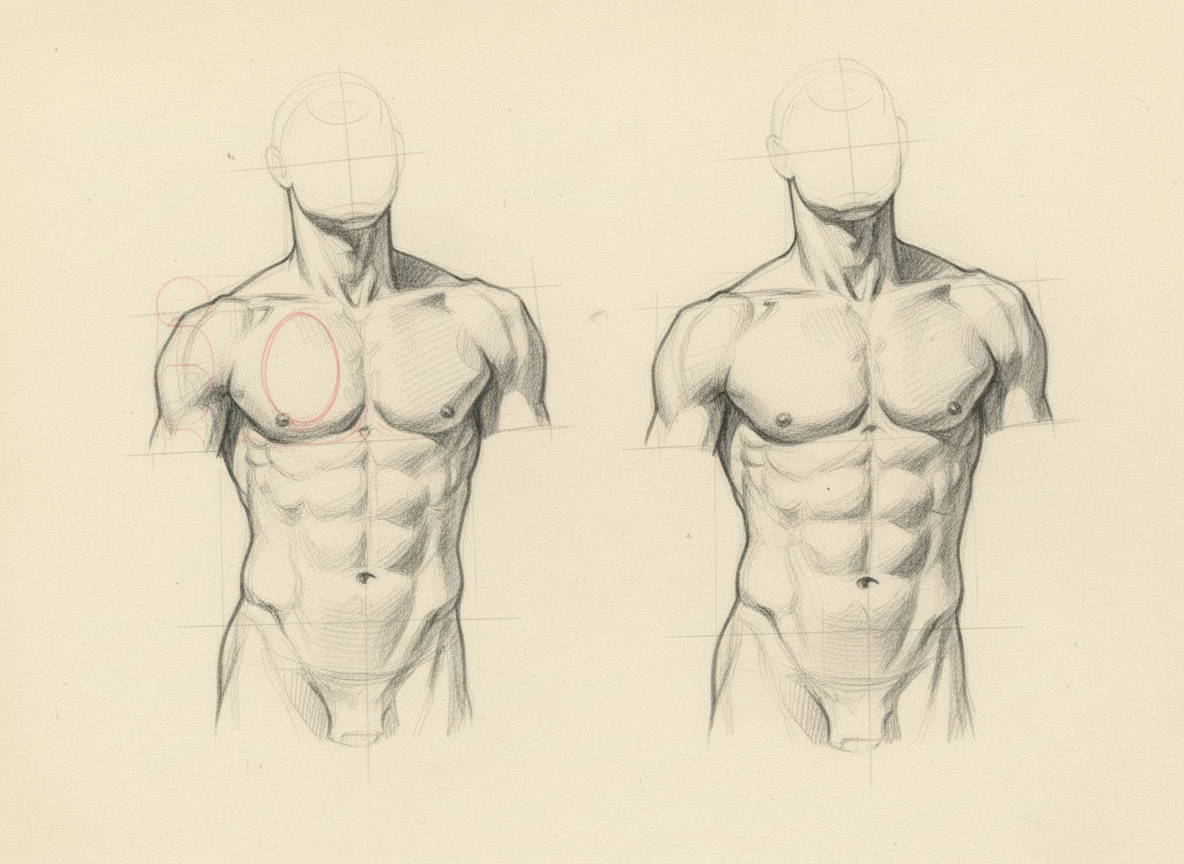
Think of the ribcage as an egg — slightly compressed from front to back, wider at the bottom than at the top, and tilted slightly backward from the vertical. This tilt is important: the ribcage does not sit perfectly upright. It leans back, which is why the chest appears to thrust forward and the upper back curves inward.
The key measurements to remember:
- Height: The ribcage spans from the clavicles (collarbones) at the top to the costal arch (the lower rib margin) at the bottom — approximately 2.5 head units in the ideal male figure.
- Width: At its widest point (around the 8th rib), the ribcage is approximately 1.5 times the width of the head.
- Depth: The ribcage is roughly as deep front-to-back as it is wide side-to-side — it is a three-dimensional form, not a flat surface.
Key Surface Landmarks
These are the landmarks that appear on the surface of the skin and give the torso its characteristic visual structure:
- The sternum (breastbone): The central vertical bone of the chest. It runs from the clavicular notch at the top to the xiphoid process at the bottom. The sternum is the anchor point for the pectoral muscles and defines the vertical centre line of the torso.
- The costal arch: The curved lower margin of the ribcage, formed by the lower ribs. In a lean male figure, this arch is clearly visible as a curved line running from the xiphoid process outward and downward to the sides of the torso.
- The clavicles (collarbones): Two curved bones that run from the sternum outward to the acromion process at the shoulder. In the male figure, the clavicles are broader and more prominent than in the female figure. Their angle and position define the width and tilt of the shoulders.
- The acromion process: The bony point at the top of each shoulder where the clavicle meets the scapula. This is the outermost point of the shoulder and the origin of the deltoid muscle.
The Shoulders: Mechanics and Muscle
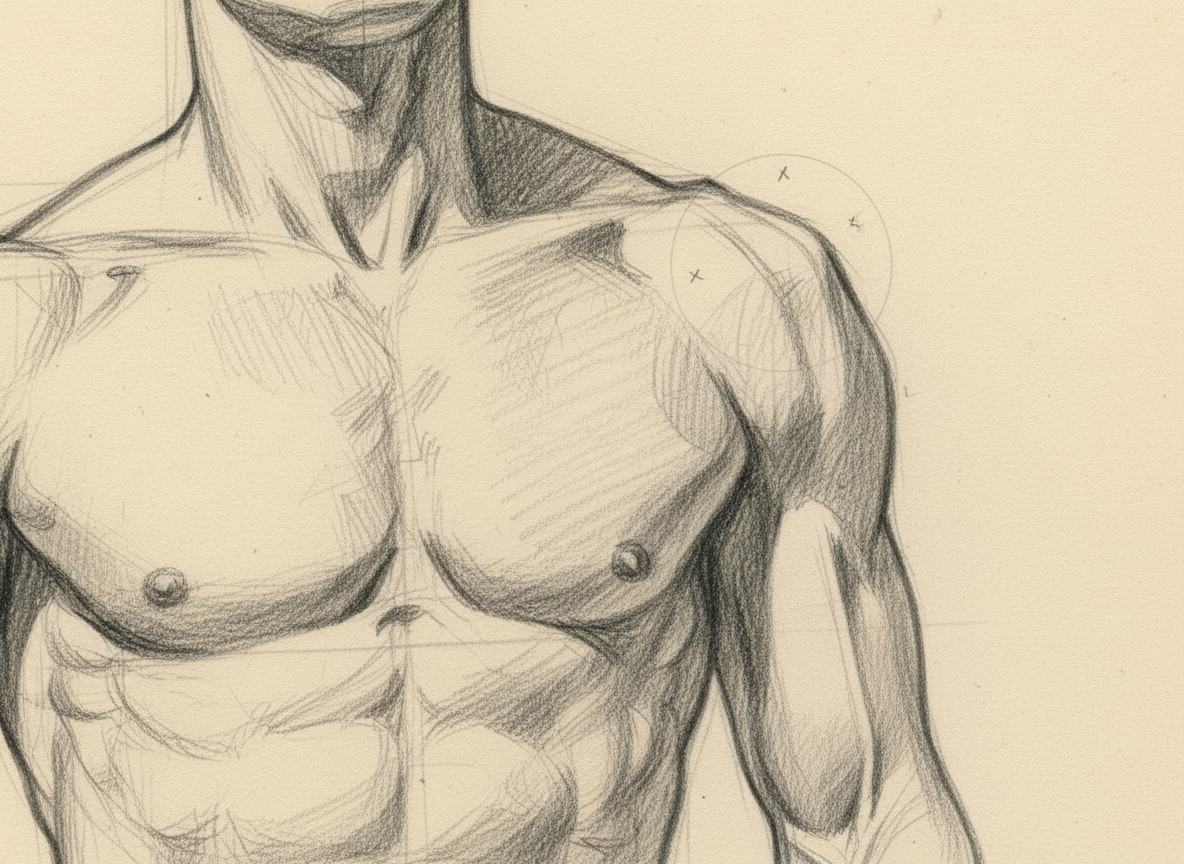
The shoulders are the most expressive part of the male torso. Their width, angle, and musculature define the characteristic silhouette of the male figure — the broad, tapering V-shape that distinguishes the male torso from the female.
The Shoulder Girdle
The shoulder girdle consists of two bones: the clavicle (collarbone) at the front and the scapula (shoulder blade) at the back. Together, they form a flexible framework that allows the arm to move in almost any direction.
The key to drawing convincing shoulders is understanding that the shoulder girdle moves independently of the ribcage. When the arm is raised, the scapula rotates upward. When the arm reaches forward, the scapula slides outward around the ribcage. This mobility is what makes the shoulder so complex — and so interesting — to draw.
The Major Shoulder Muscles
- Deltoid: The large, triangular muscle that caps the shoulder. It originates from the clavicle and acromion process and inserts into the humerus (upper arm bone). The deltoid has three heads — anterior (front), medial (side), and posterior (back) — each of which creates a distinct surface form depending on the position of the arm.
- Trapezius: The large diamond-shaped muscle of the upper back. It runs from the base of the skull and the cervical and thoracic vertebrae to the clavicle, acromion, and spine of the scapula. In the male figure, the trapezius creates the characteristic slope from the neck to the shoulder and the raised ridge of muscle visible when the head is turned.
- Pectoralis major: The large fan-shaped muscle of the chest. It originates from the clavicle, sternum, and upper ribs and inserts into the humerus. In the male figure, the pectorals create the characteristic chest mass — broader and more defined than in the female figure.
- Serratus anterior: A series of finger-like muscle slips that originate from the upper ribs and insert into the medial border of the scapula. In a lean male figure, the serratus anterior is visible on the side of the torso as a series of diagonal ridges between the pectorals and the external obliques. It is one of the most characteristic surface features of the male torso.
The Core: Abdominals and Obliques
The core muscles of the male torso — the rectus abdominis, the external obliques, and the internal obliques — create the characteristic surface texture of the lower torso. Understanding these muscles is essential for drawing the torso convincingly, particularly in dynamic poses where the torso twists or bends.
Rectus Abdominis
The rectus abdominis is the long, segmented muscle that runs vertically from the pubic bone to the lower ribs and sternum. It is divided into segments by horizontal tendinous intersections — the structures that create the visible “six-pack” in lean, muscular subjects.
Important: In most real male figures — including athletic, working-man builds — the rectus abdominis is not sharply defined. It creates a subtle surface texture, not a dramatic grid of blocks. Drawing the abdominals as a rigid six-pack is one of the most common mistakes in figure drawing, and it almost always looks artificial and unconvincing.
The linea alba — the vertical groove that runs down the centre of the abdomen — is often more visible than the individual muscle segments. This central line, combined with the natural soft tissue over the muscles, creates a more realistic and convincing abdominal form.
External Obliques
The external obliques are the large, fan-shaped muscles that run diagonally from the lower ribs to the iliac crest (the top of the pelvis). They create the characteristic diagonal surface texture on the sides of the torso — the lines that run from the lower ribs downward and inward toward the groin.
In the male figure, the external obliques are one of the most important surface features. They define the transition from the ribcage to the pelvis, create the characteristic narrowing of the waist, and interact with the serratus anterior to create the complex surface texture of the lateral torso.
The Inguinal Ligament
The inguinal ligament runs from the anterior superior iliac spine (the front point of the pelvis) to the pubic tubercle. It creates the characteristic diagonal line at the base of the torso — the “V-line” that separates the lower abdomen from the upper thigh. This line is one of the most important surface landmarks in the male figure and is essential for correctly placing the transition from torso to leg.
Drawing the Torso: A Step-by-Step Process
With this anatomical foundation in place, here is the process I use for drawing the male torso from any angle:
- Establish the ribcage and pelvis as separate masses. Draw the ribcage as an egg shape and the pelvis as a simplified wedge or bucket. Identify the tilt of each mass and the angle of the spine connecting them. This is the structural foundation of the entire torso.
- Place the shoulder girdle. Draw the clavicles as two curved lines running from the sternal notch outward to the acromion process. The angle of the clavicles determines the tilt of the shoulders and the overall silhouette of the upper torso.
- Establish the key landmarks. Mark the sternum, the costal arch, the iliac crest, and the anterior superior iliac spine. These landmarks anchor the major muscle groups and define the surface structure of the torso.
- Block in the major muscle masses. Add the pectorals, deltoids, and trapezius as simplified geometric forms. Do not detail yet — establish the overall shapes and their relationships.
- Add the secondary muscles. Add the serratus anterior, the external obliques, and the rectus abdominis. Pay particular attention to how these muscles interact and overlap.
- Refine the surface forms. Work from large shapes to small, refining the contours and adding the subtle surface details — the linea alba, the inguinal ligament, the tendinous intersections of the rectus abdominis.
- Apply tonal values. Build your shading using cross-hatching and tonal layering, following the form of each muscle group. The light source should be consistent throughout the entire figure.
Common Mistakes in Torso Drawing
- Drawing the torso as a single rigid block: Always think of the torso as two separate masses — ribcage and pelvis — connected by a flexible spine.
- Ignoring the costal arch: The lower margin of the ribcage is one of the most important surface landmarks in the torso. Its angle and position define the transition from chest to abdomen.
- Drawing fake six-packs: The rectus abdominis creates subtle surface texture, not a dramatic grid of blocks. Draw what you see, not what you expect to see.
- Neglecting the serratus anterior: This muscle is one of the most characteristic features of the lean male torso. Its diagonal finger-like slips on the side of the ribcage add realism and anatomical accuracy.
- Making the shoulders too symmetrical: In almost every pose, one shoulder is higher than the other. Natural asymmetry is essential for a convincing figure.
The Complete Path
The male torso is covered in depth in my book Mastering the Male Figure, with dedicated lessons on ribcage construction, shoulder mechanics, and core anatomy across multiple stages of the course. Combined with the pencil techniques and complete figure drawing guide covered elsewhere on this blog, you will have everything you need to draw the male torso with confidence and accuracy.