One of the most common traps in figure drawing is reaching for anatomical detail before the underlying form is established. An artist draws a pectoral muscle before they have understood the chest as a three-dimensional mass. They render abdominal segments before the torso has volume. The result is surface detail applied to a flat surface — and no amount of anatomical accuracy will fix it.
The solution is deceptively simple: learn to see form before you see anatomy. This is the foundational principle of the classical atelier tradition, and it is the fastest way to make your male figure drawings feel solid and real.
Why Form Comes Before Anatomy
Anatomy describes what is beneath the surface. Form describes what the surface looks like in light. A figure drawing is not a medical illustration — it is a record of how light falls on a three-dimensional object. Before you can draw anatomy convincingly, you must first understand the overall shape of the form and how light reveals it.
Think of the torso as an egg — a simple, three-dimensional mass. Light falls on one side. Shadow falls on the other. The transition between them is the core shadow. This is all you need to understand before you add any anatomical detail. The pectorals, the deltoids, the obliques — these are refinements of the form, not replacements for it.
The Common Mistake Artists Make
Most artists learn anatomy before they learn to see form. They study muscle names, origins, and insertions — and then try to apply this knowledge directly to their drawings. The result is a figure that looks like an anatomical diagram: technically accurate, but visually flat.
The problem is not the anatomy knowledge — it is the sequence. Anatomy should be applied to an already-established form, not used as a substitute for it. When you draw a bicep before you have established the cylindrical form of the arm, the bicep has nothing to sit on. It floats on the surface rather than emerging from the underlying structure.
The Maximus Method Approach
In the Maximus Method, every drawing begins with form, not anatomy. The sequence is non-negotiable:
- Gesture first. Capture the overall movement and weight of the pose. This is pure form — the flowing rhythm of the figure before any detail is considered.
- Simple masses second. Reduce the figure to its simplest geometric forms: the ribcage as an egg, the pelvis as a wedge, the limbs as cylinders. These are forms, not anatomy.
- Light and shadow third. Before adding any anatomical detail, establish where the light falls and where the shadow falls. Map the major shadow shapes on your simple geometric forms.
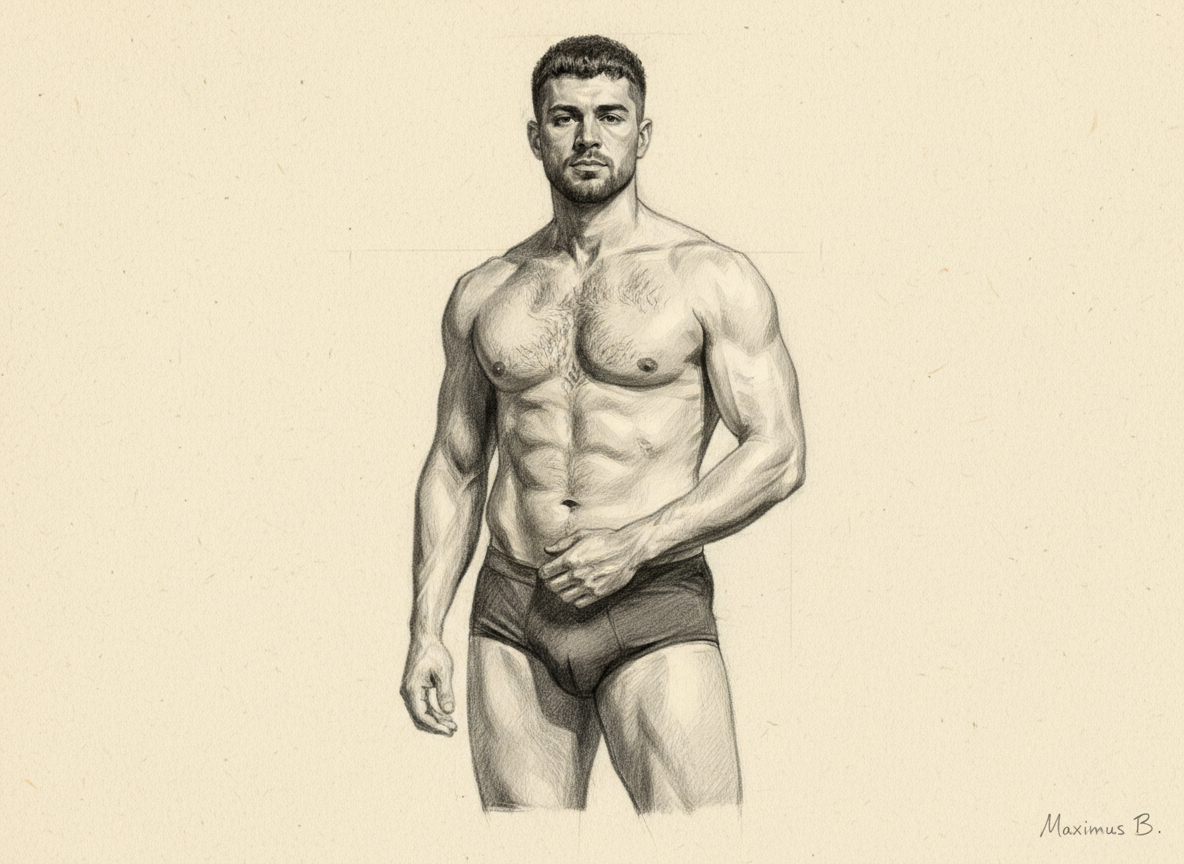
- Anatomy fourth. Only now do you begin to refine the surface with anatomical detail. The pectorals emerge from the chest mass. The deltoids emerge from the shoulder sphere. The obliques emerge from the lateral torso cylinder.
This sequence ensures that every anatomical detail has a form to sit on. The result is a drawing that feels three-dimensional from the first mark to the last.
How to Train Your Eye to See Form
Seeing form is a skill that must be trained. Here are the exercises I use and recommend:
- Squint at your reference. Squinting blurs the detail and reveals the major light and shadow shapes. Practice identifying the overall form of the figure — the big light mass and the big shadow mass — before you look at any detail.
- Draw silhouettes. Draw the figure as a solid black silhouette. This forces you to think about the overall shape and proportion rather than surface detail.
- Draw with simple shapes only. Spend 10 minutes drawing figures using only spheres, cylinders, and boxes. No anatomy, no detail — just form. This trains your eye to see the underlying structure.
- Map shadow shapes before shading. Before you begin any tonal work, lightly outline the boundary between light and shadow on every major form. This is the most important line in the drawing — it defines the form before any detail is added.
How to Practise This
Take any male figure reference and work through the following sequence:
- Draw the gesture in 30 seconds — a single flowing line from head to foot.
- Block in the major masses as simple geometric shapes — 2 minutes.
- Map the shadow shapes on these masses — 2 minutes. Do not shade yet, just outline the shadow boundaries.
- Fill the shadow areas with a flat mid-tone — 2 minutes.
- Now, and only now, begin to add anatomical refinement within the established form.
Repeat this exercise daily for two weeks. By the end, you will find that your drawings have a solidity and three-dimensionality that was previously missing — not because you learned more anatomy, but because you learned to see form first.
Final Thought
Anatomy is knowledge. Form is vision. The great draughtsmen of history — Michelangelo, Raphael, Ingres — possessed both in abundance. But they always drew form first. The anatomy was in service of the form, not the other way around.
For a complete, structured course that builds this understanding from the ground up, my book Mastering the Male Figure takes you through all six stages — from first gesture marks to fully rendered, exhibition-quality drawings — with form always as the foundation.