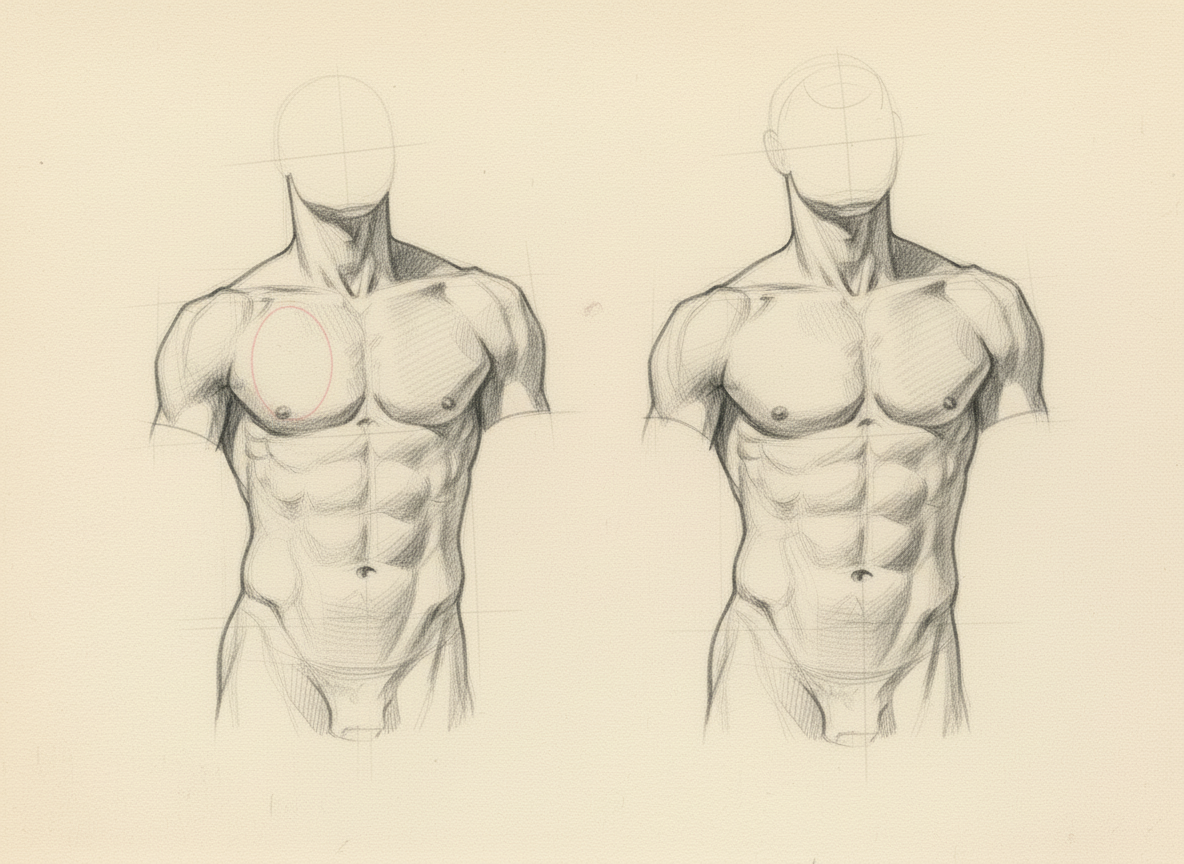
After more than 30 years of drawing and studying the male figure, I have seen the same mistakes repeated by artists at every level — from absolute beginners to experienced draughtsmen who should know better. These are not obscure technical errors. They are fundamental problems that, once corrected, produce an immediate and visible improvement in your work.
Whether you are studying in London, New York, Berlin, or teaching yourself at home, these seven mistakes — and their corrections — apply universally.
Mistake 1: Skipping the Gesture
This is the most common and most damaging mistake. Artists jump straight into contour lines and anatomical detail without first establishing the gesture — the underlying rhythm, movement, and weight of the pose.
The result: A figure that looks stiff, wooden, and lifeless, even if every muscle is rendered correctly.
The fix: Always begin with 30 seconds to 2 minutes of pure gesture drawing. Use long, flowing lines that capture the energy of the pose. The gesture line should flow from the head, through the spine, through the pelvis, and into the weight-bearing leg. Do not worry about accuracy — worry about life.
Mistake 2: Wrong Proportions from the Start
Proportion errors in the first five minutes of a drawing become catastrophic by the end. The most common: making the head too large, the torso too long, or the legs too short.
The fix: Use the head unit system. The male figure is approximately 7.5 to 8 heads tall. The halfway point is at the pubic bone — not the waist. Check your proportions before adding any detail.
Mistake 3: Drawing Symbols Instead of What You See
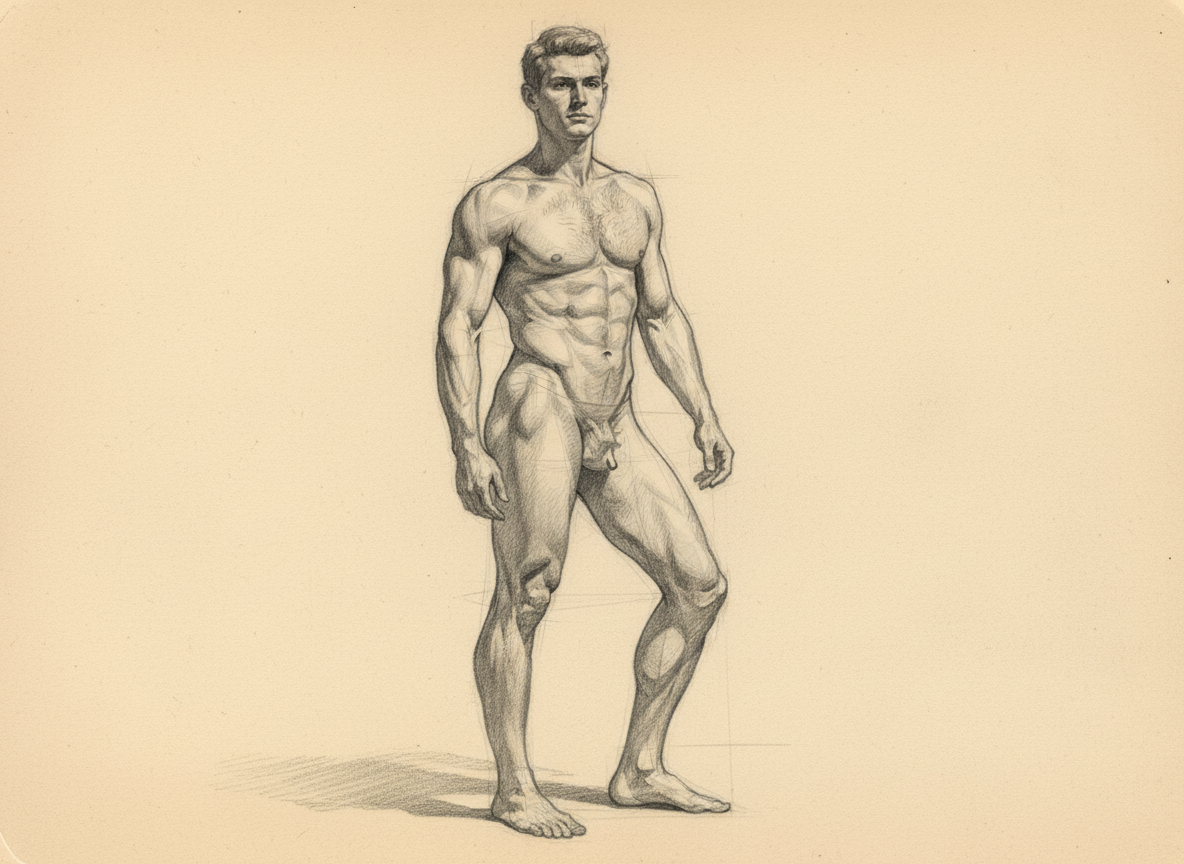
Your brain stores simplified symbols for body parts — an almond shape for eyes, a cylinder for arms, a triangle for the nose. When you draw from these symbols instead of observing the actual forms in front of you, the result looks generic and unconvincing.
The fix: Train yourself to see shapes, not objects. Instead of drawing “an arm,” draw the specific shape of the shadow on the bicep. Instead of drawing “a shoulder,” draw the exact angle of the deltoid as it catches the light. Observation is the core skill.
Mistake 4: Flat, Timid Shading
Beginners almost always shade too lightly and too evenly. The result is a flat drawing with no sense of three-dimensional form.
The fix: Commit to your value range. A convincing figure drawing needs a full spectrum from pure white (the paper) to deep black (your darkest pencil, pressed firmly). Build your tones gradually using cross-hatching and layered strokes. Identify the light source and be consistent with it throughout the entire drawing.
Mistake 5: Ignoring the Rib Cage–Pelvis Relationship
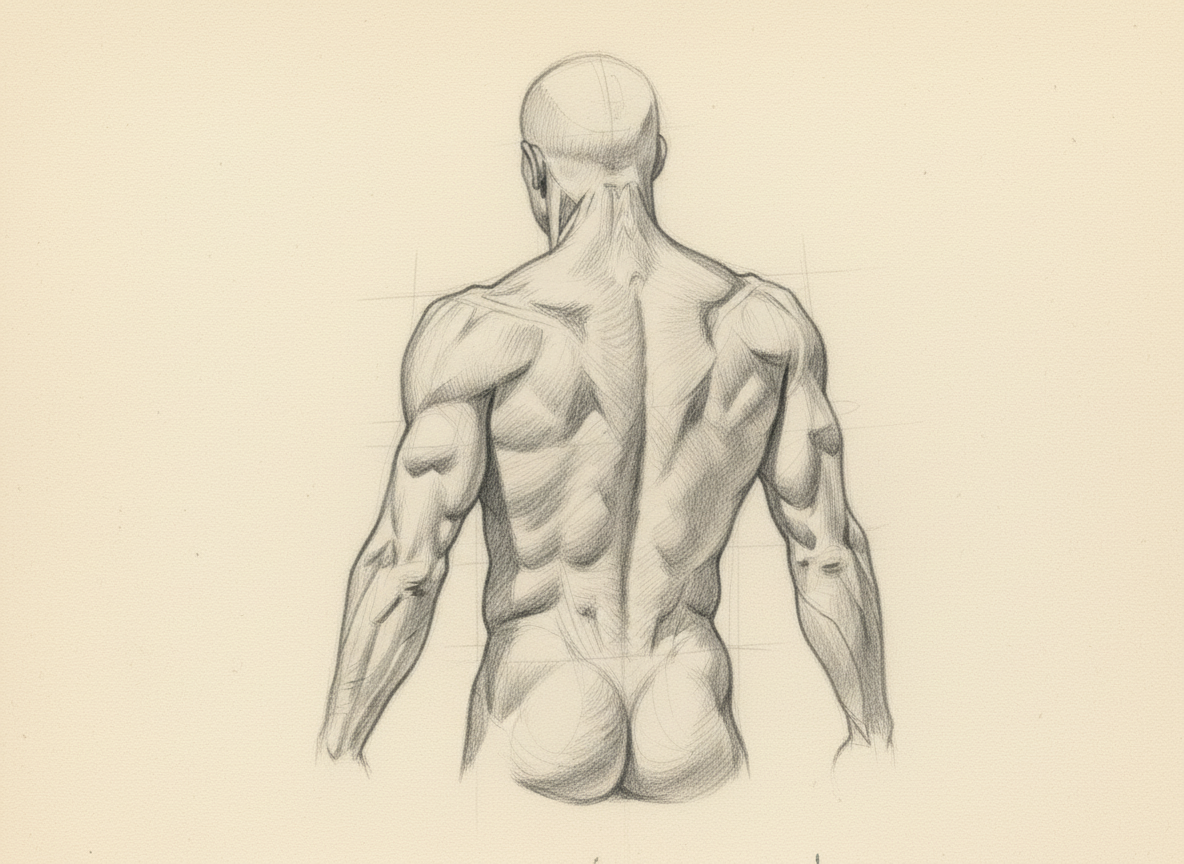
The torso is not a single block. It is two separate masses — the rib cage and the pelvis — connected by the flexible lumbar spine. In almost every pose, these two masses tilt, twist, and compress against each other in different directions.
The fix: Always draw the rib cage and pelvis as separate forms. Identify their individual tilts and the angle of the spine connecting them. This single correction will make your figures look dramatically more natural and dynamic.
Mistake 6: Neglecting the Feet and Hands
Many artists avoid feet and hands because they are difficult. The result is figures that fade out at the extremities — or worse, figures with tiny, shapeless appendages that undermine an otherwise strong drawing.
The fix: Study hands and feet separately. Dedicate entire practice sessions to them. In the male figure, hands and feet are larger and more angular than in the female figure. They are also some of the most expressive parts of the body — do not neglect them. For a complete guide, see my article on how to draw hands.
Mistake 7: Never Doing Long Studies
Quick gesture drawings are essential for developing fluency, but they are not enough on their own. Many artists never progress beyond short studies because long drawings feel intimidating.
The fix: Schedule at least one long study per week — 2 to 3 hours minimum. This is where you integrate everything: gesture, structure, anatomy, proportion, shading, and detail. Long studies are where real growth happens.
The Path Forward
Correcting these seven mistakes will not make you a master overnight, but it will accelerate your progress dramatically. Every one of these corrections is something I learned the hard way over decades of practice.
If you want a structured programme that addresses all of these issues — and many more — in a step-by-step format, my book Mastering the Male Figure takes you from first lines to finished detail across 60 progressive lessons.
For a complete foundation, start with my beginner's guide to drawing the male figure.