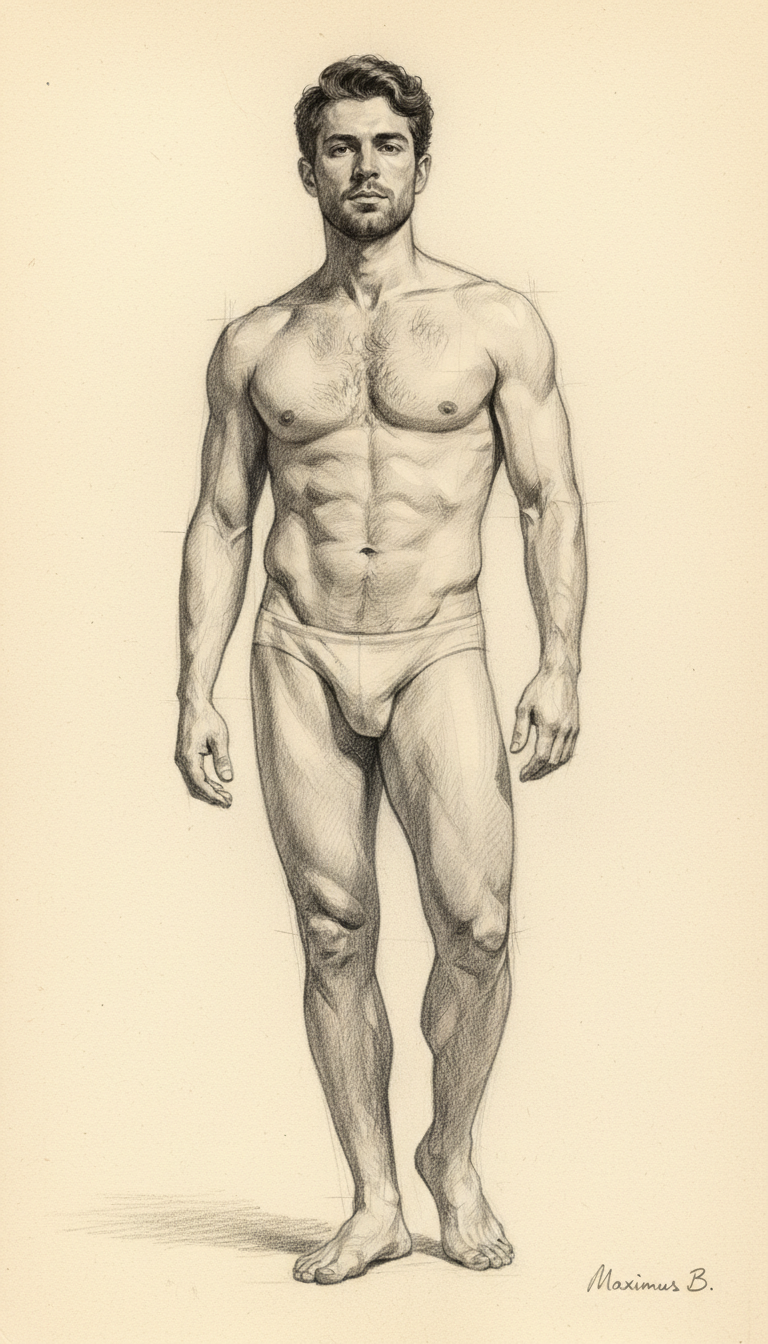
One of the most common mistakes in figure drawing is rendering the male abdomen as a rigid grid of perfectly defined blocks — the so-called “six-pack.” This approach produces drawings that look artificial, generic, and anatomically dishonest. Real abdominal structure is far more subtle, varied, and interesting than the fitness-magazine version.
In this guide, I will show you how to draw the male abdominal region as it actually appears in real, natural bodies — with the linea alba, the obliques, and the soft tissue that gives the torso its authentic character.
Why the Six-Pack Is a Drawing Trap
The rectus abdominis — the muscle responsible for the “six-pack” appearance — is a real muscle. But in the vast majority of male figures, it does not present as a sharply defined grid of blocks. Even in athletic, lean subjects, the abdominal surface is characterised by subtle undulations, not hard edges.
The problem arises when artists draw what they expect to see rather than what is actually there. The result is a torso that looks like a bodybuilding illustration rather than a classical figure study.
The Linea Alba: The True Centre Line
The linea alba is the vertical fibrous band that runs from the xiphoid process (the bottom of the sternum) down to the pubic symphysis. It divides the rectus abdominis into left and right halves and is often the most visible feature of the abdominal surface.
In your drawings, the linea alba should be rendered as a subtle groove — not a hard line. Its depth and visibility vary depending on the subject's build, the lighting angle, and the degree of muscular tension. In a relaxed pose, it may appear as nothing more than a faint shadow running down the centre of the abdomen.
The Tendinous Intersections
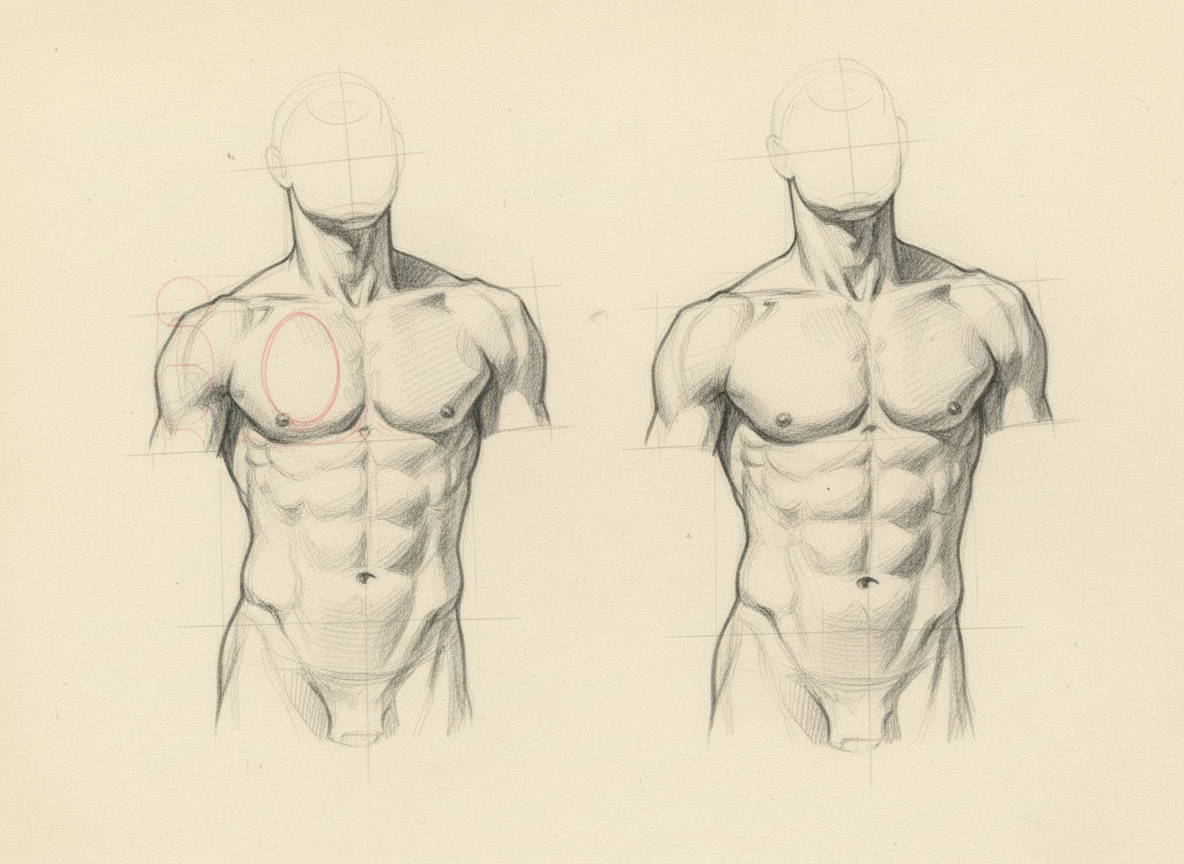
The horizontal lines that create the segmented appearance of the rectus abdominis are called tendinous intersections. There are typically three or four of these, and they are rarely symmetrical. In most subjects:
- The uppermost intersection sits just below the costal arch (the lower rib margin).
- The second intersection sits at approximately the level of the navel.
- The third (and sometimes fourth) intersection sits below the navel.
Critical observation: These intersections are not horizontal lines. They are subtle depressions in the muscle surface that catch light and shadow differently depending on the pose and lighting. Draw them as tonal variations, not as outlines.
The Role of Soft Tissue
Even in lean subjects, there is a layer of subcutaneous fat and fascia over the abdominal muscles. This layer softens the appearance of the underlying structure and creates the smooth, organic surface that characterises a natural male torso.
In your drawings, this means:
- Avoid hard edges between abdominal segments. Use soft transitions and lost edges.
- Let the light do the work. The segmented structure of the abdomen is revealed by light and shadow, not by outlines.
- Vary the definition. The upper segments of the rectus abdominis are typically more visible than the lower segments, which are covered by a thicker layer of tissue.
The External Obliques
The external obliques are the large, fan-shaped muscles on the sides of the torso. They run diagonally from the lower ribs to the iliac crest and create the characteristic diagonal lines on the lateral surface of the abdomen.
In a natural male figure, the obliques are often more visible than the rectus abdominis. They create the “V-shape” that frames the lower abdomen and define the transition from the ribcage to the pelvis. For a deeper exploration, see my guide on obliques and torso rhythm.
Drawing Process: Abdominal Structure Step by Step
- Establish the torso masses first. Draw the ribcage and pelvis as separate forms. The abdominal muscles connect these two masses — they do not exist in isolation.
- Mark the linea alba. Draw a light centre line from the xiphoid process to the pubic bone. This is your vertical anchor.
- Indicate the costal arch. The lower margin of the ribcage defines the upper boundary of the visible abdominal surface.
- Lightly suggest the tendinous intersections. Use subtle tonal shifts, not hard lines. Remember: asymmetry is natural and desirable.
- Add the obliques. Draw the diagonal surface forms on the sides of the torso, noting how they interleave with the serratus anterior above.
- Build tonal values. Use cross-hatching and tonal layering to model the subtle surface forms. Let the light source reveal the structure naturally.
Common Mistakes to Avoid
- Drawing a symmetrical grid: Real abdominal segments are rarely symmetrical. The left and right sides often differ in size, shape, and position.
- Using outlines for segments: Abdominal definition comes from tonal variation, not from drawn lines between segments.
- Making every subject look lean: Most real male figures have some soft tissue over the abdominal muscles. This is normal and should be drawn honestly.
- Ignoring the obliques: The obliques are often more visually prominent than the rectus abdominis. They frame the abdomen and give the torso its characteristic shape.
The Complete Path
Abdominal anatomy is covered in depth in my book Mastering the Male Figure, with dedicated lessons on core anatomy across multiple stages of the course. For the broader torso context, see my guide on male torso anatomy for artists.