Feet are among the most avoided subjects in figure drawing. Many artists fade them out, shrink them, or hide them behind props. Yet the foot is a structural marvel — it carries the entire weight of the figure, communicates balance and ground contact, and reveals the quality of an artist's anatomical understanding immediately.
In the male figure, feet are larger, more angular, and more architecturally complex than in the female figure. Drawing them well is not optional if you want convincing full-figure work. This guide gives you the complete anatomical foundation and a practical drawing process for male feet in classical graphite.
Why Feet Matter in Figure Drawing
The foot is the figure's connection to the ground. Its position, angle, and weight distribution communicate everything about how the figure stands, moves, and carries itself. A figure with poorly drawn feet looks ungrounded — literally and visually.
In a standing pose, the foot tells you where the weight falls. In a walking pose, it tells you the phase of the stride. In a seated pose, the foot's angle reveals the position of the entire leg. Neglect the feet, and you undermine the structural logic of the whole figure.
The Common Mistake Artists Make
The most frequent error is drawing feet as shapeless blobs — a vague wedge with five bumps at the end. This happens because artists avoid studying feet and default to a simplified symbol rather than observing the actual form.
The second mistake is making feet too small. In the male figure, the foot is approximately the same length as the forearm from wrist to elbow. Many artists draw feet at half this size, which makes the figure look unstable and toy-like.
The third mistake is ignoring the arch. The foot is not flat. It has a pronounced medial arch on the inner side, a lower lateral arch on the outer side, and a transverse arch across the ball of the foot. These arches create the characteristic silhouette of the foot and must be understood to draw it convincingly.
Foot Anatomy: The Essential Structures
You do not need to memorise every bone in the foot. But you do need to understand the key structures that create the visible surface form:
- The heel (calcaneus): The largest bone of the foot. It projects backward and downward, creating the rounded mass at the back of the foot. In the male figure, the heel is broad and angular.
- The ankle bones (malleoli): The medial malleolus (inner ankle) sits higher than the lateral malleolus (outer ankle). This asymmetry is critical — draw both ankles at the same height and the foot will look wrong.
- The arch: The medial arch rises from the heel to the ball of the foot on the inner side. In a standing figure, the inner edge of the foot does not touch the ground along its full length — only the heel, the ball, and the outer edge make contact.
- The ball of the foot: The broad padded area beneath the toes. It is the primary weight-bearing surface in walking and running.
- The toes: The big toe (hallux) is the largest and most important. The remaining toes decrease in size from the second to the fifth. In the male figure, the toes are broader and more squared at the tips than in the female figure.
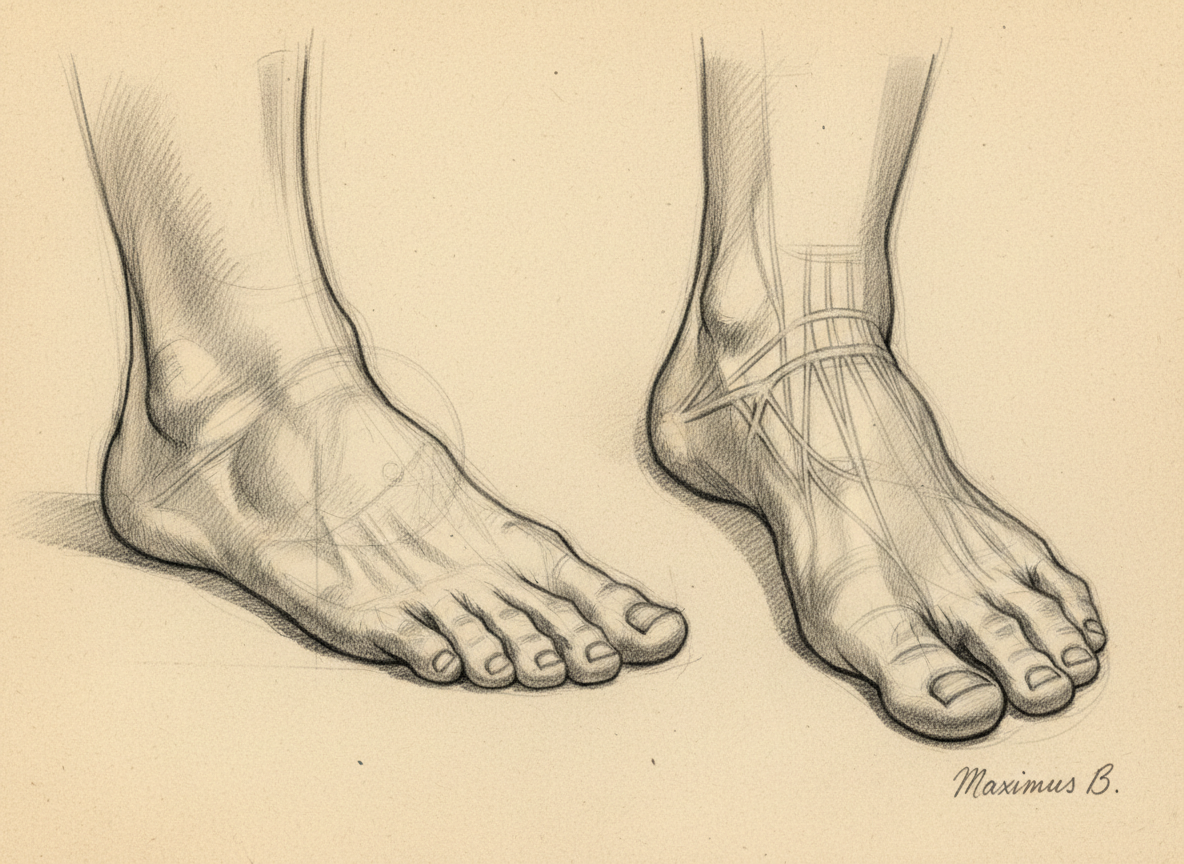
The Maximus Method Approach
In the Maximus Method, the foot is approached as a three-part structure:
- The heel block: A roughly rectangular mass, wider at the base, projecting backward from the ankle.
- The arch wedge: A tapered wedge connecting the heel to the ball of the foot. On the inner side, this wedge rises into the arch. On the outer side, it sits lower and flatter.
- The toe platform: A broad, slightly curved platform at the front of the foot, from which the toes extend.
Draw these three masses first — before any toes, before any surface detail. Establish the overall proportion, angle, and weight distribution. Only then add the toes and surface anatomy.
Drawing the Foot: Step by Step
- Establish the ankle position. Mark the medial malleolus (inner ankle) higher than the lateral malleolus (outer ankle). This asymmetry anchors the entire foot.
- Draw the heel block. A broad rectangular mass projecting backward and downward from the ankle. In the male figure, the heel is substantial — do not make it too small.
- Draw the arch wedge. From the heel, draw the inner edge rising into the arch, and the outer edge running lower and flatter. The inner arch should be clearly visible — do not flatten it.
- Establish the ball of the foot. A broad, rounded mass at the front of the foot. The ball is wider than the heel in the male figure.
- Add the toes. Start with the big toe — it is the most important. Draw it as a separate, substantial form. The remaining toes decrease in size. Note that the second toe is often longer than the big toe in many individuals.
- Add surface anatomy. The extensor tendons running across the top of the foot, the visible ankle bones, the Achilles tendon at the back. These details elevate a basic foot drawing to a convincing anatomical study.
- Build tonal values. The underside of the arch catches reflected light. The top of the foot receives direct light. The spaces between the toes are the darkest areas.
How to Practise This
The most accessible model for foot drawing is your own foot. Place it in different positions — flat on the floor, raised on tiptoe, crossed over the knee — and draw it from direct observation.
- Draw your own foot 20 times in different positions. Focus on the arch, the ankle asymmetry, and the overall proportion.
- Draw feet from reference photographs, paying particular attention to how the arch changes with different weight distributions.
- Draw feet as part of full-figure studies, ensuring they are proportionally correct and grounded convincingly.
- Study the feet in classical drawings and sculpture — the way masters like Michelangelo and Raphael drew feet is instructive.
Final Thought
The foot is not a footnote. It is the foundation of the figure — literally. When you draw feet with the same care and anatomical understanding you bring to the torso or the hands, your figures gain a completeness and conviction that is immediately visible.
Follow Maximus B. and explore Mastering the Male Figure for a complete graphite atelier approach to structure, anatomy, light and rendering.