Hands are the part of the figure that most artists dread. They are complex, expressive, and unforgiving of errors. But they are also one of the most rewarding subjects to master — and in the male figure, hands carry a particular weight and character that can elevate or undermine an entire drawing.
Over 30 years of drawing the male figure, I have developed a systematic approach to hands that takes the fear out of the process. This guide covers everything from basic construction to finished detail, using the same graphite pencil techniques I use throughout my work.
Why Male Hands Are Different
Male hands are structurally distinct from female hands in several important ways. Understanding these differences is essential for convincing figure drawing:
- Larger overall proportions: The male hand is typically wider across the palm and longer in the fingers relative to the wrist.
- More angular knuckles: The metacarpophalangeal joints (the knuckles at the base of the fingers) are more prominent and squared in males.
- Visible tendons and veins: The back of the male hand often shows more visible extensor tendons and subcutaneous veins, especially in athletic or mature subjects.
- Thicker fingers: Male fingers are generally wider and more cylindrical, with less taper toward the tips.
- Stronger thenar eminence: The muscle mass at the base of the thumb (thenar eminence) is typically more developed in males.
Step 1: The Basic Construction
Never begin a hand drawing with fingers. Always start with the overall shape — just as you would start a full figure with gesture.
- Draw the palm as a rectangle: Slightly wider at the knuckle line than at the wrist. In the male hand, this rectangle is closer to a square than in the female hand.
- Mark the knuckle line: Draw a gentle arc across the top of the rectangle. This is where the fingers attach. The middle finger knuckle is the highest point of the arc.
- Establish finger lengths: The middle finger is approximately the same length as the palm. The ring finger reaches to about the base of the middle finger's nail. The index finger is slightly shorter than the ring finger. The little finger reaches to the top knuckle of the ring finger.
- Add the thumb: The thumb originates from the side of the palm, about one-third of the way down. It angles away from the hand and has only two phalanges (not three like the fingers).
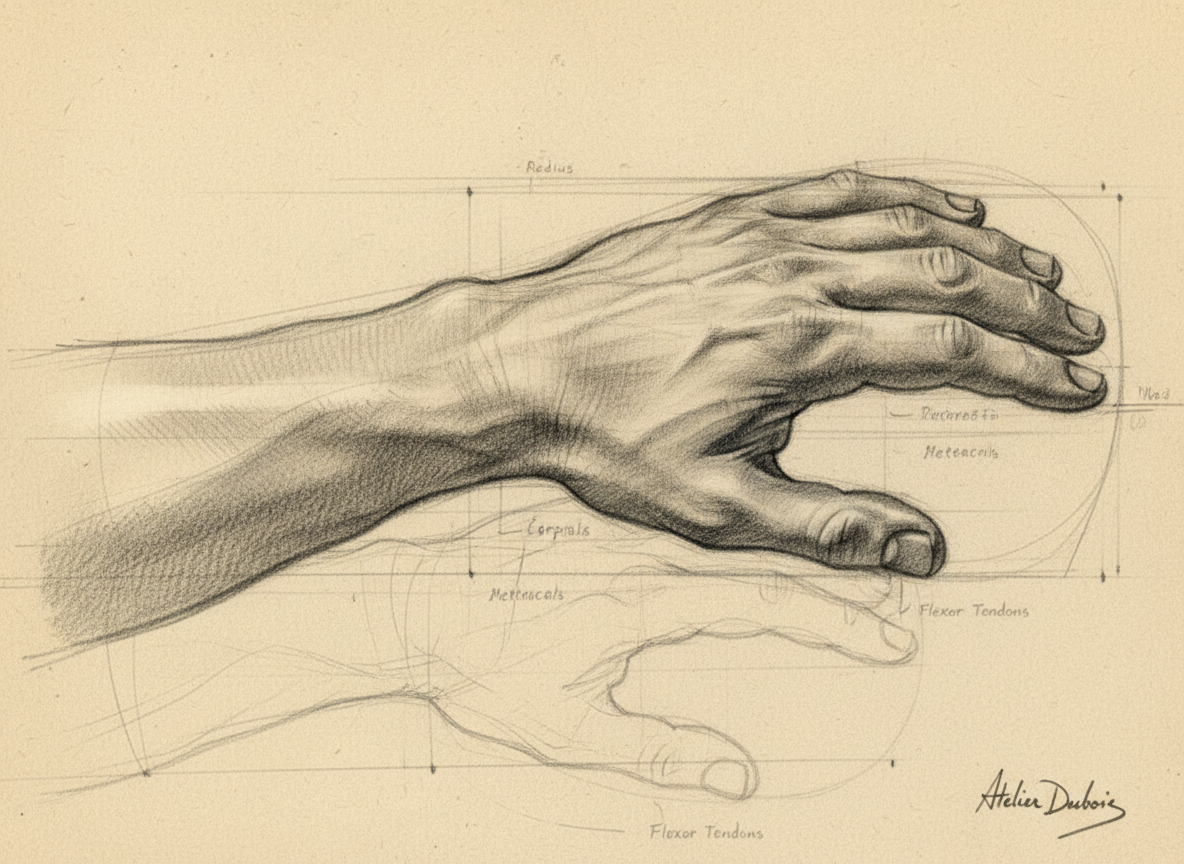
Step 2: Understanding the Knuckle Architecture
The knuckles are the key to making hands look three-dimensional and convincing. Each finger has three sets of joints:
- MCP joints (base knuckles): These form the prominent ridge across the back of the hand when the fist is clenched. In the male hand, they are angular and well-defined.
- PIP joints (middle knuckles): Slightly smaller than the base knuckles. They create a visible bump on each finger.
- DIP joints (end knuckles): The smallest joints, near the fingertips. Subtle but important for realism.
Critical observation: When the hand is relaxed, the knuckles do not align in a straight line. They form a descending arc from the index finger to the little finger. Getting this arc right is essential for a natural-looking hand.
Step 3: Drawing Tendons and Surface Anatomy
The back of the male hand is a landscape of tendons, veins, and subtle bony landmarks. These surface details are what separate a beginner's hand drawing from a professional one.
- Extensor tendons: Four visible tendons run from the wrist to each finger across the back of the hand. They become more prominent when the fingers are extended or spread.
- Veins: Subcutaneous veins create irregular, branching lines across the back of the hand. They are more visible in older or leaner subjects. Draw them with light, irregular lines — never perfectly straight.
- The anatomical snuffbox: A small depression at the base of the thumb, visible when the thumb is extended. It is a subtle but telling detail that adds realism.
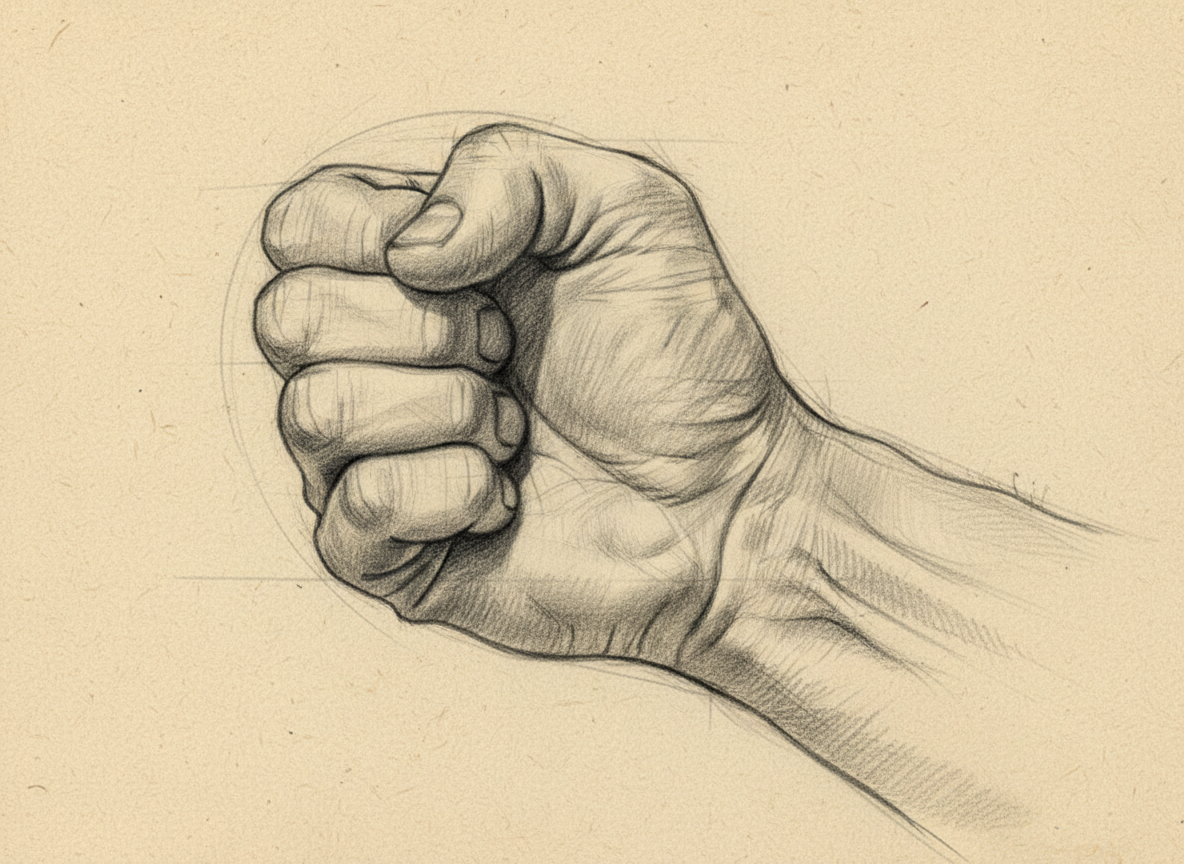
Step 4: Shading the Hand
Shading hands requires the same tonal layering approach used for the rest of the figure, but with particular attention to the small, complex forms.
- Identify the light source: Consistency with the rest of your figure drawing is essential. The hand must be lit from the same direction as the body.
- Map the major shadow shapes: The spaces between fingers, the underside of the palm, and the area beneath the thumb create the darkest shadows.
- Build tone gradually: Start with HB for the lightest areas. Use 2B for mid-tones. Reserve 4B and 6B for the deepest shadows between fingers and under the palm.
- Follow the form with your strokes: Cross-hatching lines should follow the cylindrical form of each finger and the flat planes of the palm.
Common Hand Drawing Mistakes
These are the errors I see most frequently — and the corrections that fix them:
- Sausage fingers: Drawing fingers as uniform cylinders without knuckle definition. Fix: always indicate the three joint positions on each finger.
- Flat palms: Ignoring the natural curve and depth of the palm. Fix: the palm is concave, not flat. It has a distinct hollow in the centre.
- Identical fingers: Making all four fingers the same length and width. Fix: each finger has a different length, and the index and little fingers are noticeably thinner than the middle and ring fingers.
- Stiff poses: Drawing hands in rigid, unnatural positions. Fix: observe real hands at rest — the fingers naturally curl inward, and no two fingers are perfectly parallel.
- Ignoring the wrist: Ending the hand abruptly at the wrist. Fix: the hand transitions smoothly into the forearm through the wrist bones (ulnar and radial styloid processes).
Practice Exercises
Dedicated hand practice is essential. Here are five exercises I recommend:
- Draw your own hand 20 times: In different positions — open, closed, gripping, pointing, relaxed. Your own hand is the most accessible model you have.
- Construction drills: Draw 10 hands using only the rectangle-and-cylinder construction method. No detail — just structure.
- Knuckle studies: Draw close-up studies of knuckles from different angles. Focus on the angular, bony quality of male knuckles.
- Tendon and vein mapping: Draw the back of a hand focusing only on surface anatomy — tendons, veins, and bony landmarks.
- Hands in context: Draw hands as part of a full figure, ensuring they are proportionally correct and lit consistently with the rest of the body.
Proportion Rule of Thumb
A useful proportion check: the hand, from wrist to fingertip, is approximately the same length as the face, from chin to hairline. In the male figure, the hand is slightly wider relative to its length than in the female figure.
Use this as a quick check whenever you are drawing hands as part of a full figure study. If the hand looks too small or too large, compare it to the face.
The Complete Path
Hands are covered in depth in my book Mastering the Male Figure, with dedicated lessons that progress from basic construction to fully rendered hand studies. Combined with the pencil techniques and common mistake corrections covered elsewhere on this blog, you will have everything you need to draw hands with confidence.